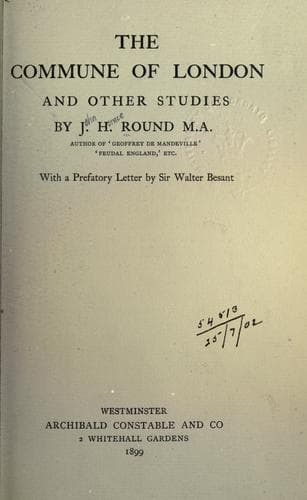
The Commune of London, and other studiesRound, John Horace
History
The Commune of London, and other studies
Round, John Horace
Great Britain -- History -- Norman period, 1066-1154; London (England) -- History -- To 1500
quia, sicut tuæ magnitudinis sane Hiberniam et omnes insulas
excellentia [? cognoscit], ... ad jus beati Petri et
Romana ecclesia aliud jus habet sacrosanctæ Romanæ ecclesiæ,
in Insula quam in terra magna quod tua etiam nobilitas
et continua, etc. recognoscit, non est dubium
pertinere.
The very fact that these coincidences are rather suggestive than
verbal, favours, I think, the theory of concoction. But I am chiefly
influenced by the fact that “Laudabiliter” does little more than
paraphrase and adapt the contents of Alexander’s letter. Even its
clause as to Peter’s pence might be based on Alexander’s insistence
that Henry was not only to guard “jura beati Petri,” but “si etiam ibi
non habet (jura)”--as was the case with Peter’s pence--to establish
them himself.
And now as to my third question: ‘Was there a conspiracy?’ I doubt
if sufficient attention has been paid to the remarkable words of the
‘Gesta Henrici,’ followed as they were by Hoveden.[416] That they were
introduced of set purpose is evident from their repetition.[417] It
should be observed that the story told in the ‘Metalogicus’ of Adrian
and in the ‘Gesta’ of Alexander is to the same effect:
METALOGICUS. GESTA HENRICI.
regi Anglorum Henrico secundo summus pontifex ... confirmavit
(Papa) concessit et dedit ei et heredibus suis regnum
Hiberniam jure hæreditario illud, et eos imperpetuum
possidendam. reges constituit.
Neither the letters in the ‘Liber Niger’ nor even the documents given
by Giraldus can justify these expressions. Yet this must have been what
we may term the view officially adopted. As the Black Book letters of
Alexander III. could not be made to support this view, its upholders
preferred to fall back on the alleged grant by Adrian, as the source of
Henry’s title, and to pretend that his successor Alexander had merely
confirmed it. “Laudabiliter” did not, it is true, go so far as was
required, but it carried back the title to Adrian’s action, and, so
far, supported the story.
* * * * *
The subsequent attitude of Rome towards the English story is a matter
of obvious interest, but, as yet, of much obscurity. Cardinal Moran
relied on the personal information of Theiner for the statement that
nowhere in the private archives, or among the private papers of
the Vatican, or in the ‘Regesta’ which Jaffé’s researches have
made so famous, or in the various indices of the Pontifical
letters, can a single trace be found of the supposed Bulls of
Adrian and Alexander.[418]
Public-domain text, read in full here on John Shaqi.
Reviews
Reviews
No reviews yet
Be the first to share your thoughts on this work.
Elsewhere in the archive
Join the Discussion
Join the discussion
Sign in to leave a comment or review.
Sign InorCreate an account