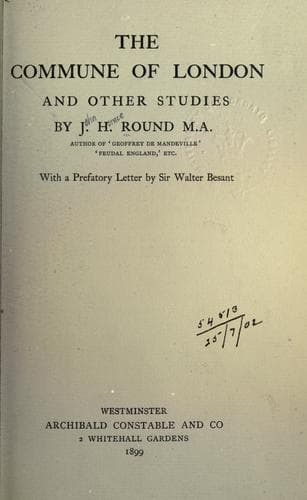
The Commune of London, and other studiesRound, John Horace
History
The Commune of London, and other studies
Round, John Horace
Great Britain -- History -- Norman period, 1066-1154; London (England) -- History -- To 1500
The zeal manifested by Henry to convert all Ireland to the faith
moved the soul of Adrian to invest him with the sovereignty of
that island. Three important conditions were annexed to the
gift. 1st. That the king should do all in his power to propagate
the Christian religion throughout Ireland. 2nd. That each of his
subjects should pay an annual tribute of one penny to the Holy
See, commonly called Peter’s pence. And 3rd. That civil liberty
should be guaranteed, and the privileges and immunities of the
Church be held inviolate.[420]
This clear testimony to the Pope’s belief, in 1645, that Adrian had, by
‘Laudabiliter,’ invested Henry II. with the sovereignty of Ireland can
hardly be agreeable reading to Father Gasquet and his friends.
IX
The Coronation of Richard I
The first coronation of an English king of which we possess a detailed
account is that of Richard I. (3rd Sept., 1189). It was carried out,
says Dr. Stubbs, “in such splendour and minute formality as to form a
precedent for all subsequent ceremonies of the sort.”[421] As a more
recent writer has observed:
The order of the procession and the details of the ceremonial
were arranged with unusual care and minuteness; it was the
most splendid and elaborate coronation-ceremony that had ever
been seen in England, and it served as a precedent for all
after-time.[422]
It is consequently of some interest to learn on what authority the
narrative of this coronation rests.
The original authority is that of the writer formerly described as
“Benedictus abbas,” but now virtually known to have been Richard ‘Fitz
Nigel,’[423] who was not only a contemporary writer, but, as the king’s
Treasurer, would probably have been an actual spectator of the ceremony
he describes. His account is repeated by Hoveden,[424] who was also a
contemporary, and possibly present, but “adds only matter of extremely
small importance.”[425] We then come to Matthew Paris, writing some two
generations later, who gives, says Dr. Stubbs--
a similar account of the coronation, more closely resembling
that of Benedict ... in the few and unimportant places where
the two differ. He indicates the common source of information,
the Rolls (ed. Wats, p. 154) or Consuetudines (Abbreviatio, Ed.
Madden, iii. 209) of the Exchequer.[426]
This view was accepted by Dr. Luard (1874), who says of the narrative
given by Matthew in his Chronica Majora (ii. 348–350):
This account is taken from Benedict. The original source (the
Consuetudines Scaccarii) is referred to in the Hist. Angl., ii.
p. 8, and the Abbreviatio Chronicorum, iii. 209. See Madden’s
note, iii. 209.[427]
We are thus referred to Sir Frederic Madden, who, as keeper of the MSS.
at the British Museum, possessed special knowledge, and who wrote thus
(1869):
Public-domain text, read in full here on John Shaqi.
Reviews
Reviews
No reviews yet
Be the first to share your thoughts on this work.
Elsewhere in the archive
Join the Discussion
Join the discussion
Sign in to leave a comment or review.
Sign InorCreate an account