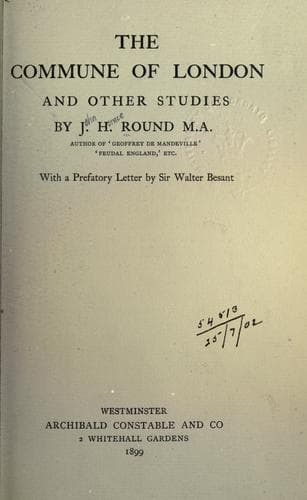
The Commune of London, and other studiesRound, John Horace
History
The Commune of London, and other studies
Round, John Horace
Great Britain -- History -- Norman period, 1066-1154; London (England) -- History -- To 1500
It is here, with Mr. Hall, the same as elsewhere. His work is marred,
throughout, by that confusion of thought which makes it almost
impossible to learn what he really means.
In any case my own position is clear. I assert that the note by Matthew
Paris refers, not to the narrative of the coronation, which he derived
from the ‘Gesta,’ but to a description of the “services”; and I hold
that he found this description, not in a lost Exchequer record, but in
the Red Book’s account of Queen Eleanor’s coronation.
X
The Struggle of John and Longchamp
(1191)
It is needless to insist on the critical character of the year 1191 in
England. From the moment when the watchers on the coast of Sicily had
seen the passing of Richard, this country found itself, for the first
time, cut off, for all purposes, from communication with its king. The
sovereign had gone, and his seal with him; and ministerial government,
a government by officials, was thrown on its own resources. If Henry
and his grandfather had taught their subjects faithfully to obey the
ministers of the Crown, with the king ever at their back, the case
was altered when the king had left them for a distant land. And men’s
thoughts turned to John, not only as the visible representative, in his
brother’s absence, of his house, but as not improbably their future
king, and that, it might be, before long. John, traitor at heart, saw
the strength of his position, and Longchamp was far too clever to
ignore the danger of his own.
To the tale of their inevitable strife for power, the acknowledged
master of that age’s history has devoted special care. In his edition
of the ‘Gesta Regis Ricardi’ (1867), and again in that of Hoveden
(1870), he has given the conclusions at which he arrived concerning
the order of events in 1191. We have, in the former, the footnote to
vol. ii., pp. 208–9, and in the latter, pp. lvi.-lxiv. of the preface
to vol. iii., and the “long note” on pp. 134–5 of the text. The last of
these is perhaps the one which sets forth most fully and clearly the
final conclusions of the bishop. These conclusions, I may add at once,
have been accepted without question by Mr. Howlett, in his ‘William of
Newburgh’ (1884)[434] and his ‘Richard of Devizes’ (1886),[435] by Miss
Norgate in her ‘England under the Angevin Kings’ (ii. 298–301) and her
Life of Longchamp,[436] and by Mr. Hunt in his Life of John.[437]
Summing up the narratives found in the ‘Gesta,’ Hoveden, Richard
of Devizes, and William of Newburgh, Dr. Stubbs holds that their
“divergency arises from the fact of the struggle falling into two
campaigns, in which certain details are repeated. There were three
conferences at Winchester, two attempts on the chancellor’s part to
seize the castle of Lincoln, and two settlements.” He then gives “the
harmonized dates, on this hypothesis, in detail.”
Public-domain text, read in full here on John Shaqi.
Reviews
Reviews
No reviews yet
Be the first to share your thoughts on this work.
Elsewhere in the archive
Join the Discussion
Join the discussion
Sign in to leave a comment or review.
Sign InorCreate an account