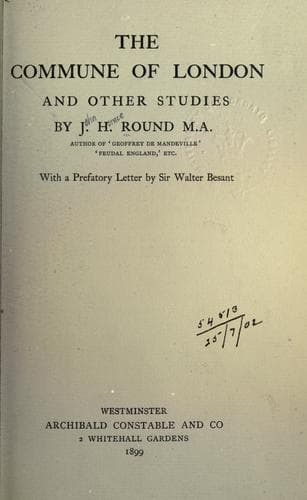
The Commune of London, and other studiesRound, John Horace
History
The Commune of London, and other studies
Round, John Horace
Great Britain -- History -- Norman period, 1066-1154; London (England) -- History -- To 1500
The solution, therefore, which I propound is that the narrative of the
coronation, which is admittedly derived from the ‘Gesta,’ was written
by its author from his own knowledge, and certainly not derived by him
from an Exchequer record. In the first place, it is nowhere said that
he did so; in the second, it is little less than absurd to assume that
Richard would refer to a record in his own Exchequer for a ceremony
which must have taken place while he was writing his chronicle, and at
which he was probably present. The idea arose, as I have shown, from
a simple misunderstanding, and has led those who adopt it to direct
self-contradiction, for if Matthew derived, as admitted, his narrative
from the ‘Gesta,’ he could not also have derived it, as Dr. Luard
writes, from some Exchequer record.
As Richard had not described the coronation _services_, Matthew,
for these, refers us to that precedent preserved at the Exchequer
(Eleanor’s coronation), which was, we shall find, the recognised
precedent for coronation services so late as 1377.[432]
We may now pass to Mr. Hall’s theory that the non-appearance in the
Red Book of “the order of Richard I.’s Coronation, referred to (as he
holds) by Matthew Paris, is a third instance of palpable omission”[433]
of transcripts it formerly contained. His only reason for denying that
the above marginal notes refer (as I hold) to Eleanor’s coronation
(1236) is that “Hoveden, Bromton, and other authorities give an
abbreviated narrative” which implies the existence of such a record as
is supposed to have been lost. But Hoveden, as we have seen, copies
his narrative from the ‘Gesta,’ which he does not abbreviate, but
expands--and does not describe the “services,” which is what we want.
Mr. Hall’s meaning, however, is, as usual, obscure; for, having cited
the supposed narrative as at one time existing in our Red Book (p.
xviii.), he next tells us: “It can scarcely be doubted that Matthew
Paris’ reference was to some Exchequer Precedent Book which no longer
exists” (p. xix.), although, we read, it was certainly from our
existing Red Book that he took his “description of the pageant of 1236”
(pp. xix., xxxii.). He calls it the “custumal” (_consuetudinarium_) of
the Exchequer. And yet on page xxix. we read of Matthew referring to the
‘custumal’ of the Exchequer wherein a certain document of the
reign of Richard I. is said to have been entered, which no
longer exists in the Red Book or in any other Exchequer MS.
So also we learn, on page lxii., that Swereford compiled a lost work
“which was the custumal known to Matthew Paris, and the probable
exemplar of the Red Book of the Exchequer.” So Matthew’s ‘custumal’
(_consuetudinarium_) was not the Red Book itself, but its now lost
“exemplar.” Yet on page xix. we are told that this, the only ‘custumal’
mentioned by Matthew, was, beyond doubt, the Red Book of the Exchequer.
Public-domain text, read in full here on John Shaqi.
Reviews
Reviews
No reviews yet
Be the first to share your thoughts on this work.
Elsewhere in the archive
Join the Discussion
Join the discussion
Sign in to leave a comment or review.
Sign InorCreate an account