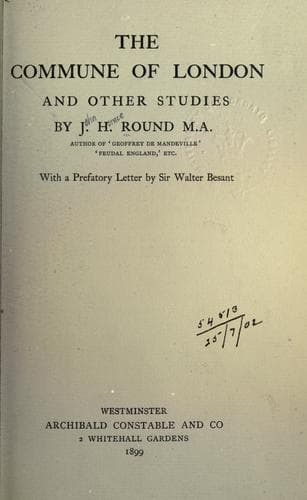
The Commune of London, and other studiesRound, John Horace
History
The Commune of London, and other studies
Round, John Horace
Great Britain -- History -- Norman period, 1066-1154; London (England) -- History -- To 1500
Occupying as it did, among English towns, a position apart, in wealth
as in importance, London had a municipal development of her own, a
development of which our best historians can only tell us that it
is “obscure.” That obscurity, however, has been sadly increased by
the careless study and the misapprehension of her great charters of
liberties. Broadly speaking, and disregarding for the moment the
statements of our accepted authorities, the great want of London, in
her early days, was an efficient, homogeneous government of her own.
The City--for the City was then London--found itself in fact, during
the Norman period, in the same plight as greater London found itself
in our own days. “The ordinary system of the parish and the township,”
as an accomplished writer has observed, “the special franchises and
jurisdictions of the great individual landowners, of the churches, of
the gilds--all these were loosely bundled together.” For the cause
of this state of things we should have to go back to the origins of
our history, to show that the genius of the Anglo-Saxon system was
ill-adapted, or rather, wholly unsuitable, to urban life; that, while
of unconquerable persistence and strength in small, manageable rural
communities, it was bound to, and did, break down when applied to
large and growing towns, whose life lay not in agriculture, but in
trade. In a parish, a “Hundred,” the Englishman was at home; but in a
town, and still more in such a town as London, he found himself, for
administrative purposes, at his wits’ end.
Putting aside the “English Knightengild,”--the position of which as a
governing body has been far too rashly assumed,[465] and rests upon
no foundation,--the only institutions of which we can be sure are the
“folkesmote” and the weekly “husteng” of Henry I.’s charter, and the
Shrievalty. The “folkesmote” was the immemorial open-air gathering,
corresponding with the “shire-moot” or “hundred-moot” of the country,
the “borough-moot” or “portman-moot” of the town. The small “husteng,”
as is obvious from its name, was a Danish development, akin to the
“lawmen” of the Danish boroughs. If these represented, in London, a
kind of legal unity, the shrievalty, on the other hand, involved a kind
of financial unity. If, however, as I have urged in my study on the
early shrievalty,[466] the administrative development of London had
proceeded upon these lines, it would no more have brought about a true
municipal unity than the sheriff and the county court could evolve it
in the shire; a “Corporation” was wholly alien to administration on
county principles.
Public-domain text, read in full here on John Shaqi.
Reviews
Reviews
No reviews yet
Be the first to share your thoughts on this work.
Elsewhere in the archive
Join the Discussion
Join the discussion
Sign in to leave a comment or review.
Sign InorCreate an account