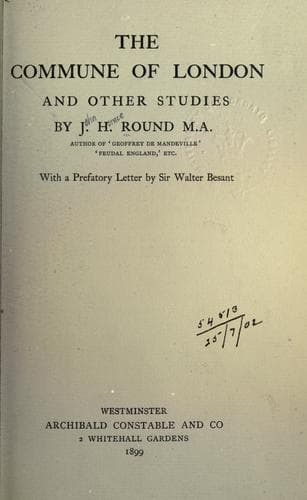
The Commune of London, and other studiesRound, John Horace
History
The Commune of London, and other studies
Round, John Horace
Great Britain -- History -- Norman period, 1066-1154; London (England) -- History -- To 1500
But in the meanwhile, the great movement in favour of municipal
liberties, which was so prominent a feature of the stirring 12th
century, was spreading like wildfire through France and Flanders, and
London, which, since the coming of the Normans, had become far more
cosmopolitan, was steadily imbibing from foreign traders the spirit
and enthusiasm of the age. But this by no means suited the views, at
the time, of the Crown, which, here as in Germany, looked askance on
this alarming and, too often, revolutionary movement. When the history
of London at this period comes to be properly studied, it will be
found that the growing power of the Londoners, who had practically
seated Stephen on the throne, and had chevied the Empress Matilda from
their midst, were sharply checked by her son Henry, whose policy, in
this respect at least, was faithfully followed by his successor,
Richard the First. The assumption, therefore, that the Mayoralty of
London dates from Richard’s accession (1189) is an absolute perversion
of history. There is record evidence which completely confirms the
memorable words of Richard of Devizes, who declares that on no terms
whatever would king Richard or his father have ever assented to the
establishment of the “Commune” in London.[467]
Writing mainly for experts, I need scarcely explain that the “sworn
Commune,” to give it its right name--for the oath sworn by its members
was its essential feature--was the association or ‘conspiracy’ as
we choose to regard it, formed by the inhabitants of a town that
desired to obtain its independence. And the head of this Association
or “Commune” was given, abroad, the title of “Maire.” It was at about
the same time that the “Commune” and its “Maire” were triumphantly
reaching Dijon in one direction and Bordeaux in another, that they
took a northern flight and descended upon London. Not for the first
time in her history the Crown’s difficulty was London’s opportunity.
Even so early as 1141, when the fortunes of the Crown hung in the
balance between rival claimants, we find the citizens forming an
effective “conjuratio,”[468] the very term applied to their “Commune,”
half a century later, by Richard of Devizes.[469] Moreover, earlier
in the same year (April), William of Malmesbury applies to their
government the term “communio,” in which the keen eye of the bishop
of Oxford detected “a description of municipal unity which suggests
that the communal idea was already in existence as a basis of civic
organization.”[470] But he failed, it would seem, to observe the
passage which follows and which speaks of “omnes barones, qui in eorum
communionem jamdudum recepti fuerant.” For in this allusion we discover
a distinctive practice of the “sworn commune,” from that of Le Mans
(1073),[471] to that of London, now to be dealt with.
Public-domain text, read in full here on John Shaqi.
Reviews
Reviews
No reviews yet
Be the first to share your thoughts on this work.
Elsewhere in the archive
Join the Discussion
Join the discussion
Sign in to leave a comment or review.
Sign InorCreate an account