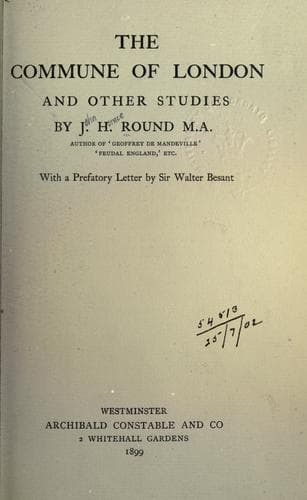
The Commune of London, and other studiesRound, John Horace
History
The Commune of London, and other studies
Round, John Horace
Great Britain -- History -- Norman period, 1066-1154; London (England) -- History -- To 1500
Here we have the explanation of an otherwise singular phenomenon. The
Crown, which was receiving, as has been shown, £547 “numero” a year
from the sheriffs of London and Middlesex, obtained less than half
that amount when its own _custodes_ were in charge! The proceeds for
the first whole year were £238 5_s._ 7_d._ “numero,” and out of this,
moreover, it had to pay Peter Fitz Walter £20 for his services, and the
clerks and serjeants (_servientes_) employed under him £8 10_s._; thus
the net receipts were only some £200 “de exitu firme de Londonia et de
Middilsexa.”[483] I infer from this that the _ferm_ extorted for London
and Middlesex had been shamefully high,[484] and that this was the
cause of the sheriffs being often laden with debt when they went out of
office,[485] as they had to make good, out of their own pockets, the
difference between the proceeds of the dues and the ferm exacted by the
Crown. It is possible that this was indeed the reason of four sheriffs,
as in 1130, being so often appointed; the loss would thus be spread
over a wider area, and the chance of recovering the debt greater. The
system, on this hypothesis, was strangely analogous to that by which,
at the present day, appointment as sheriff of a county is equivalent
to exaction of a fine by the Crown. Combining, as I have elsewhere
suggested, the fact that in 1130 each of the four sheriffs gave £12
to the Crown to be quit of his office with the clause in the earliest
charter to Rouen that no citizen should be compelled to serve as
sheriff against his will, we may certainly conclude that such sheriffs
were the victims of Crown extortion. But obscurity must still surround
the manner of their appointment.
There remains the salient fact that the Crown undoubtedly suffered a
heavy annual loss by the substitution of _custodes_ for sheriffs
in 1174. As this is a fact new to historians, one is tempted to seek
an explanation. The Crown’s loss being the city’s gain, it is at least
worth consideration that the change virtually synchronized with the
king’s arrival in London at the crisis of the feudal revolt. He was
welcomed, Fantosme tells us, by the citizens, and reminded
Ke nul peiist le Lundreis traïtres apeler.
Ne fereient traïsun pur les membres colper.
In the previous year he had been assured that they were
La plus leale gent de tut vostre regné.
Ni ad nul en la vile ki seit de tel eë
Ki puisse porter armes, ne seit très bien armé.
This testimony is in harmony with the fact they gave the Crown that
year (1173) a _novum donum_ of 1,000 marcs, supplemented by 100
marcs apiece from three leading citizens. It is, therefore, perfectly
possible that, as Rouen obtained from Henry II. a charter increasing
its privileges, as a reward for its attitude in the rebellion, London
may have been similarly rewarded by what was in practice financial
relief.
Public-domain text, read in full here on John Shaqi.
Reviews
Reviews
No reviews yet
Be the first to share your thoughts on this work.
Elsewhere in the archive
Join the Discussion
Join the discussion
Sign in to leave a comment or review.
Sign InorCreate an account