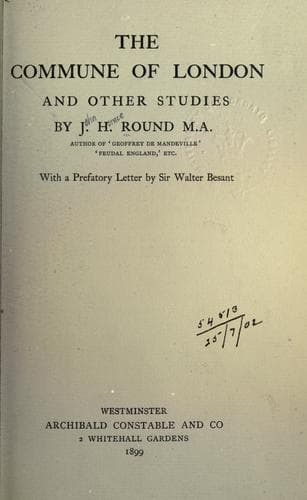
The Commune of London, and other studiesRound, John Horace
History
The Commune of London, and other studies
Round, John Horace
Great Britain -- History -- Norman period, 1066-1154; London (England) -- History -- To 1500
In ‘Geoffrey de Mandeville’ (pp. 357–9) I insisted on the necessity
of keeping steadily in view the annual _firma_ of London and
Middlesex, and showed that it was due in respect of the two jointly,
and not, as has been alleged of Middlesex, apart from London. The
further publication of the Pipe Rolls has enabled me to develop this
position. While the citizens, as I showed, strenuously claimed to hold
the city and county at ferm for £300, as in the charter of Henry I.,
the Crown no less persistently strove to exact a _firma_ of more
than £500. The exact amount of the high _firma_ is first recorded
at the change of shrievalty in 1169. The four outgoing sheriffs at
Easter of that year account for £250 “blank” and £11 “numero,” as the
half-year’s _firma_. This represents a total for the year of £500
“blank” and £22 “numero,” which is also precisely the sum accounted
for in 1173–4.[476] The whole sum would thus amount to £547 “numero,”
by the Exchequer system. But at Midsummer, 1174, there was a great
and a sudden change. Brichtmer de Haverhelle and Peter Fitz Walter
came into office not as sheriffs, but “ut custodes,” in the Exchequer
phrase,[477] and at Michaelmas they accounted not “de firma,” but “de
exitu firme.”[478]
The sheriff farmed his county and answered for a fixed _firma_,
as a tenant is responsible for his rent; the ‘custos,’ acting for the
Crown, like a bailiff for a landowner, was responsible only for the
actual proceeds (_exitus_). This distinction meets us even on the
earliest Pipe Roll (1130).[479] It is obvious that, on the _firma_
system, the sheriff might make a profit or a loss, according as the
sources of the ferm provided more or less than the rent for which he
had to account. But the point on which I am anxious to insist is that
the sources of his ferm were by no means so elastic as is alleged.[480]
As Professor Maitland observes:
The king’s rights are pecuniary rights; he is entitled to
collect numerous small sums. Instead of these he may be willing
to take a fixed sum every year, or, in other words, to let his
rights to farm.
He further describes these rights, in the case of a borough, as
“the profits of the market and of the borough court,” together with
“the king’s burgage rents.” Each of these sources, again, could be
sub-farmed.[481] This being so, I cannot agree with Dr. Stubbs in
holding that
the sheriff was answerable to the Crown for a certain sum, and
... nothing was easier than to exact the whole of the legal sum
from the rich burghers, and take for himself the profits of the
shire; or to demand such sums as he pleased of either, without
rendering any account.[482]
For the sources of the ferm were well defined: they were limited to
certain “rights.” The burgage rents were fixed; so, we believe, were
the tolls; and the fines arising from the courts cannot have varied
much. Outside these sources the sheriff had no right to “exact”
anything from the burghers.
Public-domain text, read in full here on John Shaqi.
Reviews
Reviews
No reviews yet
Be the first to share your thoughts on this work.
Elsewhere in the archive
Join the Discussion
Join the discussion
Sign in to leave a comment or review.
Sign InorCreate an account