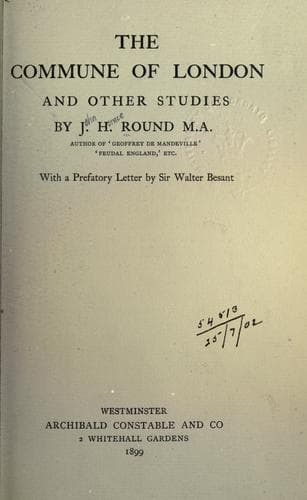
The Commune of London, and other studiesRound, John Horace
History
The Commune of London, and other studies
Round, John Horace
Great Britain -- History -- Norman period, 1066-1154; London (England) -- History -- To 1500
“I solemnly declare that I will be good and true to our
Sovereign lady Queen Victoria, that I will be obedient to the
Mayor of this City, that I will maintain the franchises and
customs thereof, and will keep this City harmless in that which
in me is; that I will also keep the Queen’s peace in my own
person, that I will know no gatherings nor conspiracies made
against the Queen’s peace, but I will warn the Mayor thereof or
hinder it to my power; and that all these points and articles I
will well and truly keep according to the laws and customs of
this City to my power.”
The obligations of allegiance to the Sovereign, of obedience to the
Mayor, and of keeping the King’s peace against all attempts to disturb
it, remain, it will be seen, in force.
* * * * *
On the importance, in many aspects, of this unique document it is
hardly necessary to dwell. Its _formulæ_ deserve to be carefully
compared with the oaths of allegiance and of the peace; but here
one must restrict attention to its bearing on the _commune_ of
London. For the first time we learn that the government of the city
was then in the hands of a Mayor and _échevins_ (_skivini_).
Of these latter officers no one, hitherto, had even suspected the
existence. Dr. Gross, indeed, the chief specialist on English municipal
institutions, appears to consider these officers a purely continental
institution.[493] But in this document the Mayor and _échevins_ do
not exhaust the governing body. Of Aldermen, indeed, we hear nothing;
but we read of “alii probi homines” as associated with the Mayor and
_échevins_. For these we may turn to another document, fortunately
preserved in this volume, which shows us a body of “twenty-four”
connected with the government of London some twelve years later
(1205–6).
* * * * *
“_Sacramentum xxiiij^{or} factum anno regni regis
Johannis vij^{o}._
Quod legaliter intendent ad consulendum secundum suam
consuetudinem juri domini regis quod ad illos spectat in
civitate Lond[onie] salva libertate civitatis et quod de nullo
homine qui in placito sit ad civitatem spectante aliquod premium
ad suam conscientiam reciperent. Et si aliquis illorum donum
aut promissum dum in placitum fatiat illud nunquam recipient,
neque aliquis per ipsos vel pro ipsis. Et quod illi nullum
modum premii accipient, nec aliquis per ipsos vel pro ipsis,
pro injuria allevanda vel pro jure sternendo. Et concessum est
inter ipsos quod si aliquis inde attinctus vel convictus fuerit,
libertatem civitatis et eorum societatem amittet.”[494]
* * * * *
Of a body of twenty-_four_ councillors, nothing has hitherto been
known. To a body of twenty-_five_ there is this one reference:
Hoc anno fuerunt xxv electi de discretioribus civitatis, et
jurati pro consulendo civitatem una cum Maiore.[495]
Public-domain text, read in full here on John Shaqi.
Reviews
Reviews
No reviews yet
Be the first to share your thoughts on this work.
Elsewhere in the archive
Join the Discussion
Join the discussion
Sign in to leave a comment or review.
Sign InorCreate an account