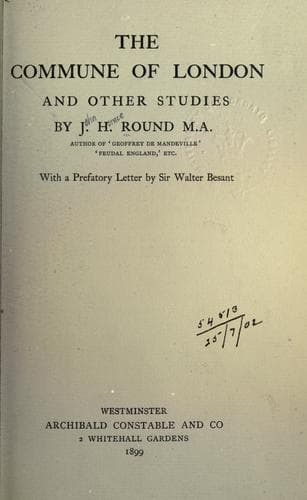
The Commune of London, and other studiesRound, John Horace
History
The Commune of London, and other studies
Round, John Horace
Great Britain -- History -- Norman period, 1066-1154; London (England) -- History -- To 1500
The year is Mich. 1200–Mich. 1201; but the authority is not first-rate.
Standing alone as it does, the passage has been much discussed. The
latest exposition is that of Dr. Sharpe, Records Clerk to the City
Corporation:
Soon after John’s accession we find what appears to be the
first mention of a court of aldermen as a deliberative body.
In the year 1200, writes Thedmar (himself an alderman), “were
chosen five and twenty of the more discreet men of the city and
sworn to take counsel on behalf of the city, together with the
mayor.” Just as, in the constitution of the realm, the House of
Lords can claim a greater antiquity than the House of Commons,
so in the City--described by Lord Coke as _epitome totius
regni_--the establishment of a court of aldermen preceded
that of a common council.[496]
Mr. Loftie, however, had pointed out several years before that this
view was erroneous:
It has sometimes been assumed that this was the beginning of the
court of aldermen. As we have seen, however, the aldermen were
in existence long before, and the question is how far they were,
under ordinary circumstances, the councillors and assistants of
the mayor.[497]
To any one, indeed, who realizes what the Aldermen were it should be
obvious that the passage in question could not possibly apply to them.
In his larger work, Mr. Loftie held that these councillors eventually
became “identified with the aldermen,” but he brought out the very
important point that their number could not be that of the wards.
The twenty-five councillors who advised the Mayor in the reign
of King John had gradually become identified with the aldermen;
and this title, which at first was applied to the heads of trade
guilds and other functionaries, was henceforth confined to the
rulers of the wards.
[NOTE]. It has been suggested that the twenty-five
councillors came from the twenty-five wards, but a chronological
arrangement of the facts disposes of this idea. There were
not twenty-five wards then in existence--moreover, it would
be necessary to account for twenty-six, if the mayor is
reckoned.[498]
As, then, they were not representatives of the wards their character is
left obscure. But when we turn to the foreign evidence, the nature of
the twenty-four becomes manifest at once; and we find in it conclusive
proof that the Commune of London derived its origin from that of Rouen.
M. Giry’s able treatise on the “Établissements de Rouen” shows us the
“Vingt Quatre” forming the administrative body, annually elected, which
acted as the Mayor’s Council. And the oath they had to take on their
election, as described in the ‘Établissements,’ bears, it will be seen,
a marked resemblance to that of the “xxiiij^{or}” in London.
Public-domain text, read in full here on John Shaqi.
Reviews
Reviews
No reviews yet
Be the first to share your thoughts on this work.
Elsewhere in the archive
Join the Discussion
Join the discussion
Sign in to leave a comment or review.
Sign InorCreate an account