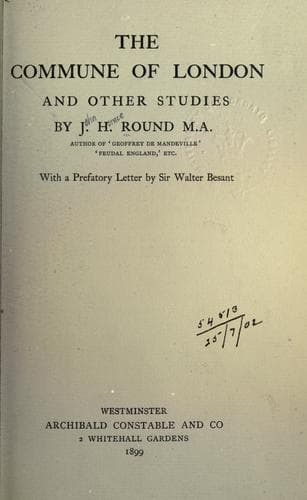
The Commune of London, and other studiesRound, John Horace
History
The Commune of London, and other studies
Round, John Horace
Great Britain -- History -- Norman period, 1066-1154; London (England) -- History -- To 1500
Nor does the interest of this Rouen charter stop here. Among the
sureties for the young Duke’s fidelity to his word we find Richer
de Laigle, the youthful friend of Becket, “a constant visitor,” as
Miss Norgate, writes, “and intimate friend of the little household in
Cheapside.” And does not the name of Becket remind us how “Thomas of
London, the burgher’s son,” afterwards “Archbishop, saint and martyr,”
had for his father a magnate of London, but one who was by birth a
citizen of Rouen? Therefore, the same writer is probably justified in
maintaining that “the influence of these Norman burghers was dominant
in the city.” They seem, she adds, “to have won their predominance by
fair means, fairly. They brought a great deal more than mere wealth;
they brought enterprise, vigour, refinement, culture, as well as
political progress.”[511]
Now it is my contention that political progress was represented with
them by the communal idea. Their interests, moreover, would be wholly
commercial, and, therefore, opposed to those of the native territorial
element. If we turn to Rouen, we find its Mayor occurring fifteen years
at least before the Mayor of London, and styled Mayor of the “Commune”
of Rouen--“Major de Communia.” For Rouen was a stronghold of the
“Commune.” It is of importance, therefore, for our purpose to ascertain
at what period the communal organization originated at Rouen. In spite
of the close attention, from the days of Chéruel downwards, that the
subject has attracted in France, the conclusions attained cannot be
deemed altogether satisfactory.
The monograph devoted by M. Giry to the “Établissements de Rouen,”[512]
represents the _fine fleur_ of French historical scholarship, and
its conclusions, therefore, deserve no ordinary consideration. But on
one point of the utmost importance, namely, the date at which these
“Établissements” were compiled, I venture to hold an independent view.
The initial difficulty is thus stated by the brilliant French scholar:
L’original n’existe plus, et l’on ne sait à quelle époque
précise il faut faire remonter leur adoption dans les villes de
Rouen et de la Rochelle qui les ont eus avant tous les autres
(p. 2).
The first allusion to the jurisdiction exercised by the Commune of
Rouen is found, says M. Giry, in the charter granted it by Henry II.
shortly after its gallant defence against the French king. He then
proceeds:
Public-domain text, read in full here on John Shaqi.
Reviews
Reviews
No reviews yet
Be the first to share your thoughts on this work.
Elsewhere in the archive
Join the Discussion
Join the discussion
Sign in to leave a comment or review.
Sign InorCreate an account