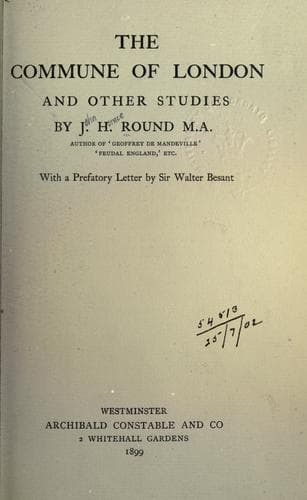
The Commune of London, and other studiesRound, John Horace
History
The Commune of London, and other studies
Round, John Horace
Great Britain -- History -- Norman period, 1066-1154; London (England) -- History -- To 1500
Hostile though our kings might be to the communal movement here, they
favoured it for purposes of their own in their Norman dominions.
This is a factor in the problem that we cannot afford to overlook,
considering the peculiar relation in which Normandy stood to England.
As M. Langlois has observed:
Jamais en effet la France et l’Angleterre n’ont été, même de nos
jours, aussi intiment en contact ... Jusqu’à la fin du xii^{me}
siècle, les deux pays eurent à peu près les mêmes institutions
politiques, ils pratiquaient la même religion, on y parlait la
même langue. Des Français allaient fréquemment dans l’île comme
touristes, comme colons, comme marchands.
Was it not then from Normandy that London would derive her commune? And
if from Normandy, surely from Rouen. We are apt to forget the close
connections between the two capitals of our Anglo-Norman kings, London
on the Thames, and Rouen on the Seine. A student of the period has
written of these:
Citizens of Norman origin, to whom London, in no small measure,
owed the marked importance which it obtained under Henry I....
Merchants, traders, craftsmen of all sorts, came flocking
to seek their fortunes in their sovereign’s newly-acquired
dominions, not by forcible spoliation of the native people, but
by fair traffic and honest labour in their midst.... Norman
refinement, Norman taste, Norman fashions, especially in dress,
made their way rapidly among the English burghers.... The great
commercial centre to which the Norman merchants had long been
attracted as visitors, attracted them as settlers now that it
had become the capital of their own sovereign.[510]
* * * * *
It is known from the ‘Instituta Londoniæ’ that, so far back as the
days of Æthelred, the men of Rouen had traded to London, bringing in
their ships the wines of France, as well as that mysterious “craspice,”
which it is the fashion to render “sturgeon,” although there is
reason to believe that the term denoted the porpoise and even the
whale. The charter of Henry, duke of the Normans, to the citizens of
Rouen (1150–1), brings out a fact unknown to English historians, by
confirming to them their port at Dowgate, as they had held it from the
days of Edward the Confessor. And the same charter, by securing them
their right to visit all the markets in England, carries back that
privilege, I believe, to the days at least of Henry I.; for, although
the fact had escaped notice both in France and England, it could
neither have originated with Count Geoffrey nor with Duke Henry his son.
Public-domain text, read in full here on John Shaqi.
Reviews
Reviews
No reviews yet
Be the first to share your thoughts on this work.
Elsewhere in the archive
Join the Discussion
Join the discussion
Sign in to leave a comment or review.
Sign InorCreate an account