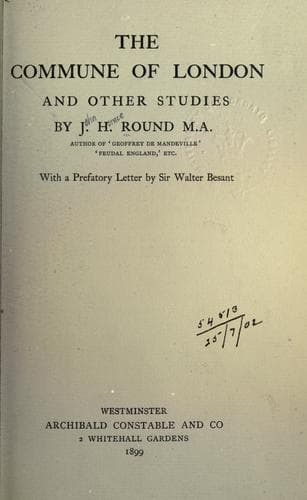
The Commune of London, and other studiesRound, John Horace
History
The Commune of London, and other studies
Round, John Horace
Great Britain -- History -- Norman period, 1066-1154; London (England) -- History -- To 1500
We have here a remarkable group of men--Longchamp himself, whose fall,
in 1191, was so closely connected with the birth of the _commune_, but
who is here seen, in the hour of his pride, speaking of “our brother,”
“our seneschal,” “our chamberlain,” “our chaplain,” “our almoner,”
and “our clerks”; Bishop Hugh, who was next year to take the lead in
expelling him from the Tower, as yet his stronghold; Henry of Cornhill
and Richard Fitz Reiner, who had ceased but a few months before to be
sheriffs of London, and who were to play so prominent a part at the
crisis of 1191; lastly, Henry Fitz Ailwin himself, who, as the ultimate
result of that crisis, was destined to become the first Mayor of the
_Commune_ of London.
The grantee himself also was a well-known citizen of London. In
conjunction with Henry Fitz Ailwin (as Mayor) and other City
magnates, he witnessed a gift of property in the City to St. Mary’s,
Clerkenwell;[518] and he seems to have been the Geoffrey Blund who had,
by his wife Ida de Humfraville, a son Thomas, who founded a chantry
in St. Paul’s for his uncle Richard de Humfraville, and his father
Geoffrey.
For the London topographer also this charter has an interest, as land
in St. Lawrence Jewry, and St. Mary Aldermanbury, must have closely
adjoined the site of the Guildhall itself. The sum named is a large one
for the time.
I now pass to the two documents of which mention has been made above.
The first of these[519] is of interest for its bearing on the “ward”
system. At Rouen the “excubia” was in charge of the mayor;[520] in
London, according to this document, he had not supplanted the sheriffs,
by whom it must have been controlled before his appearance. This I
attribute to its close connexion with the pre-existing system of
“wards,” each, I take it, a unit for purposes of defence and ward,
under its own alderman, with the sheriffs at the head of the whole
system.
DE EXCUBIIS IN NATALI ET PASCHA ET PENTECOST.[521]
Magna custodia debet invenire xii homines sed per libitum
vicecomitis abbreviata est usque ad viii homines.
Mediocris custodia debet viii vigiles, sed ita abbreviata usque
sex.
Minor custodia debet sex, sed ita abbreviata usque ad iiij^{or}.
Debent autem escavingores[522] eligi qui singulis diebus a
vigilia Nat[alis] domini usque ad diem epyphanie videant illos
qui debent de nocte vigilare quod sint homines defensibiles et
decenter ad hoc armati. Debent autem ad vesperam in die videri
et ad horam completorii exire et per totam noctem pacifice
vigilare et vicum salve custodire usque pulsetur ad matutinas
per capellas, quod vocatur _daibelle_. Et si aliqua defalta in
custodia contigerit, escavingores debent illos inbreviare et ad
primum hustingum vicecomitibus tradere. Potest eciam vicecomes,
si vult, cogere eos jurare de defalta quod nulli inde deferebunt
nec aliquem celabunt.
DE CARTIS CIVITATIS.
Public-domain text, read in full here on John Shaqi.
Reviews
Reviews
No reviews yet
Be the first to share your thoughts on this work.
Elsewhere in the archive
Join the Discussion
Join the discussion
Sign in to leave a comment or review.
Sign InorCreate an account