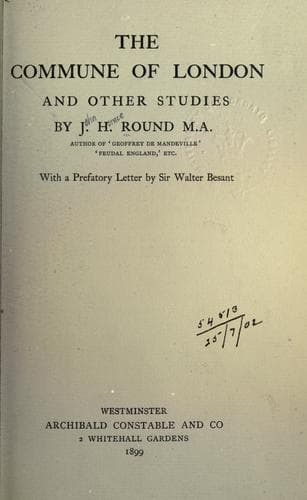
The Commune of London, and other studiesRound, John Horace
History
The Commune of London, and other studies
Round, John Horace
Great Britain -- History -- Norman period, 1066-1154; London (England) -- History -- To 1500
The “original” return and the two texts all begin with the “Honour”
of William de Windsor, who inherited from his Domesday ancestor,
Walter fitz Other, a compact block of four manors, East and West
Bedfont, Stanwell, and Hatton, in the south-west of the county. The
first entry is for East Bedfont, and the second ran, in the “original”
return: “_Walterius_ Bedestfont, Andreas Bucherel, feudum unius
militis.” But _Walterius_, Mr. Hall tells us, was altered in a
contemporary hand to “in alterius.” The ‘Testa’ renders this as “in
villa alterius,” while the ‘Red Book’ gives us “Walterius de Bedefonte,
Andreas Bukerellus j feodum.” There can be no question that the ‘Testa
de Nevill’ is right, and that Andrew Bucherel was the sole tenant of
the fee, for the scutage is accounted for accordingly on the same page
(p. 361). It follows, therefore, that the ‘Red Book’ and the “original”
return have both evolved, in error, a Walter de Bedfont from “in
alteri” Bedfont. Hence I conclude that the strip of parchment termed
by Mr. Hall “the original return,” was not the original return, and
that the error common to the ‘Red Book’ and itself demonstrates a close
connection between the two.
But if this document was not the original return, what was? To answer
this question, we must turn to Worcestershire, one of the counties
cited by Mr. Hall for the parallel character of the returns. How
significantly close is the parallel these entries will show:
Comes Albemarlie j militem et Comes Albemarlie tenet
dimidium in Severnestoke, pro Savernestokede dono regis Ricardi
qua et Kenemertone et Botintone per servicium j militis et
in Gloucestresyra Rex acquietat dimidii pro qua et pro Kenemerton
abbatem Westmonasterii de iij et Botinton in Glouc[estresyra]
militibus (‘Liber Rubeus,’ p. dominus Rex acquietat abbatem
567). Westmonasterii de iij militibus
(‘Testa de Nevill,’ p. 43).
It will be obvious, from the verbal concordances, that instead of
representing, as Mr. Hall holds, two “independent” returns made in
different years these texts are derived from one and the same return.
But instead of being, as in the case of Middlesex, arranged in the
same order, they are here found, in the respective texts, arranged
in very different order. The explanation of this is that the ‘Testa’
records the Inquest by Hundreds, while the ‘Red Book’ groups the fees
under the barons’ names and the sergeanties apart at the end. This is
particularly interesting from the parallel of Domesday Book, where
the Inquest, of which the original returns were drawn up hundred by
hundred, was rearranged in Domesday Book in similar fashion. I was led
to suspect that this great Inquest was, generally at least, drawn up by
Hundreds, from Mr. Hall’s remark that
Public-domain text, read in full here on John Shaqi.
Reviews
Reviews
No reviews yet
Be the first to share your thoughts on this work.
Elsewhere in the archive
Join the Discussion
Join the discussion
Sign in to leave a comment or review.
Sign InorCreate an account