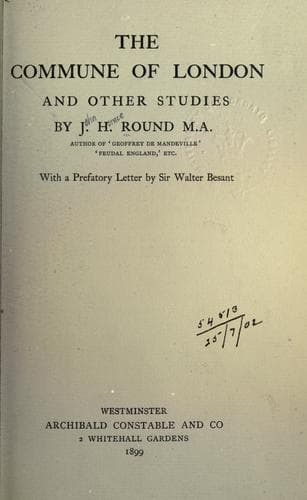
The Commune of London, and other studiesRound, John Horace
History
The Commune of London, and other studies
Round, John Horace
Great Britain -- History -- Norman period, 1066-1154; London (England) -- History -- To 1500
be evident that though (in the printed text at least) the ‘Testa’ is
not perfect, the ‘Red Book’ list, for Northumberland, is, when compared
with it, worthless.
Indeed, the marvellously elaborate returns for Somerset and Dorset,
Lincolnshire, Lancashire, etc., printed in the ‘Testa de Nevill,’ with
which the meagre lists in the ‘Liber Rubeus’ cannot be compared for an
instant, make one read with absolute amazement Mr. Hall’s statement,
when comparing the two, that
one or the other is in its present form lamentably incomplete.
This deficiency chiefly exists on the side of the _Testa_,
for it will be evident at once that the isolated and
fragmentary membranes which formed the sole surviving contents
of Nevill’s _Testa_ in the reign of Edward I. cannot be
satisfactorily compared with the relatively complete returns
preserved in the Red Book (p. ccxxiv.).
It is evident that the editor has no conception how many and how long
are the returns in the ‘Testa’ relating to this great Inquest.[542]
This may be due to his conception that they are there headed “De
Testa de Nevill” (p. ccxxv.), an idea which he repeated in a lengthy
communication to the ‘Athenæum’ (10th Sept., 1898) on the “Testa de
Nevill.” Mr. Hall wrote:
The really important point about the whole matter is one which
seems to have been entirely overlooked, namely that not only
does the title ‘Testa de Nevill’ refer to certain antique lists
alone, which, indeed, form but a small percentage of the whole
register, but that the greater part of the lists thus headed
appear to have been made at a certain date in the fourteenth
year of John.... ‘_De_ Testa de Nevill’ is the invariable
heading of these lists (p. 354).
The very point of the matter is that, on the contrary, the greater
portion of these lists have no such heading, but are hidden away among
later returns, from which they can only be disentangled by careful and
patient labour.[543] The result of my researches is that I believe the
printed ‘Testa’ to contain no fewer than a hundred columns (amounting
to nearly an eighth of its contents) representing returns to this
Inquest. At the close of this paper I append a list of these columns,
of which only thirty-eight are headed (or included in the portion
headed) “De testa de Nevill.”
To resume. For the great Inquest of 1212 (14 John) we have (1) mention
in a chronicle, (2) the writ directing it to be made, (3) the record
of a sworn verdict of jurors who made it. For the alleged Inquests of
1210–12 (12 and 13 John) we have nothing at all.[544] We have, further,
the fact that, when collated, the returns said to belong to these
“independent” Inquests are found to be clearly derived from a single
original. In spite, therefore, of the ‘Red Book’ and its editor, it may
safely be asserted that there was but one Inquest, that of the 14th
year, the returns to which were handed in on 25th June (1212).
Public-domain text, read in full here on John Shaqi.
Reviews
Reviews
No reviews yet
Be the first to share your thoughts on this work.
Elsewhere in the archive
Join the Discussion
Join the discussion
Sign in to leave a comment or review.
Sign InorCreate an account