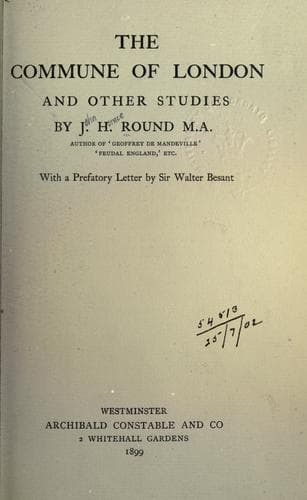
The Commune of London, and other studiesRound, John Horace
History
The Commune of London, and other studies
Round, John Horace
Great Britain -- History -- Norman period, 1066-1154; London (England) -- History -- To 1500
In the Inquisitions ... of the years 1210–11 entered in the Red
Book of the Exchequer, Walter Tosard is returned as holding his
land in Banningham.... In the original return, dated 1212, from
which the earliest list of Feudal services in _Testa de Nevill_
was compiled, we find that Walter Tosard _held_ this serjeanty,
and that Avicia Tosard still holds it (p. ccxxviii.).
The apparent discrepancy of the two returns is explained, exactly as in
the case of Theobald Walter, by the fact that the full return mentioned
Walter Tosard as dead, while the brief and inaccurate abstract of it,
in the Red Book of the Exchequer, gives his name as if he were alive.
Passing over the elaborate entry for Bradwell, Essex,[538] the two
versions of which, it will be found, are clearly derived from the same
original, I pass, in conclusion, to the return for Northumberland
(‘Testa,’ 392–3). Although not among the counties cited above by Mr.
Hall, its return to the “Inquisicio facta de tenementis, etc., que
sunt data vel alienata,” etc.,[539] is specially full and valuable
for comparison. Its text appears to reproduce the original _in
extenso_. Now any one comparing this return with the meagre list
in the ‘Liber Rubeus’ (pp. 562–4) will perceive at once that the
latter is derived from the same original. The names occur in identical
order. The only discrepancy is that the ‘Red Book’ shows us “Sewale
filius Henrici” in possession of land (Matfen and Nafferton)--held by
the interesting serjeanty of being coroner--while the ‘Testa’ reads
“Philippus de Ulkotes tenet terram que fuit Sewall’ filii Henrici.” It
might be urged, as is done by Mr. Hall in the case of the serjeanties
and the Boulogne Inquest (pp. ccxxviii., 575), that this proves the
‘Testa’ return to be the later of the two. But here, again, the real
explanation is that--as in the case of Lancashire, where Theobald
Walter’s name, we saw, is given in the ‘Red Book’ when he was dead--the
appearance of Sewal is merely due to the carelessness, in the ‘Red
Book,’ of the scribe. This, indeed, is evident from his similar
appearance in a list which is, according to Mr. Hall, later than
either.[540] How essential it is to collate these parallel lists is
shown by the very first entry, relating to the interesting tenure of
earl Patrick (of Dunbar). According to the ‘Testa’ (the right reading)
he held “iij villas in theynagio.” The ‘Red Book’ makes him hold “iii
milites (!) in theynagio,” a reading which its editor accepts without
question. Another no less striking correction is afforded by the
‘Testa,’ in its entry relating to the porter of Bamborough Castle and
his tenure: “Robertus Janitor de Bamburg’ tenet.” In Mr. Hall’s text we
find him as “Robertus, junior” (!), and, as such, the unfortunate man
is indexed, although he appears elsewhere, both in the ‘Red Book’ and
the ‘Testa,’ as “Robertus Portarius.”[541] From these instances it will
Public-domain text, read in full here on John Shaqi.
Reviews
Reviews
No reviews yet
Be the first to share your thoughts on this work.
Elsewhere in the archive
Join the Discussion
Join the discussion
Sign in to leave a comment or review.
Sign InorCreate an account