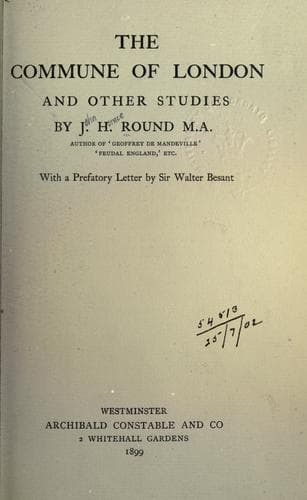
The Commune of London, and other studiesRound, John Horace
History
The Commune of London, and other studies
Round, John Horace
Great Britain -- History -- Norman period, 1066-1154; London (England) -- History -- To 1500
The first group in importance comprises the so-called
Castle-guard Rents,’ lists of military services in connection
with the Constableship of Dover Castle ... the Constableship of
Windsor Castle, the Wardship of Bamburgh Castle, and the Cornage
Rents of Northumberland (p. ccxxxvi.).
The corrupt but curious list of the Dover “wards” and their fees is
printed virtually in duplicate on pages 613, 717, though dated by the
editor in the former instance ‘1211–12’ throughout, and in the latter,
‘1261–2,’ and even ‘_Temp._ Edw. I.’ (pp. 721–2). The first of these,
from internal evidence, is probably the right date; the remaining list
(pp. 706 _et seq._), though headed in the MS. 46 Hen. III., is merely
this old list rearranged, with a money payment substituted for the
military service. I mention this because, as printed, these lists are
most misleading to any one unacquainted with their real date.
The ‘Constable’s Honour,’ for which, alone, we have six or seven
slightly varying returns, is one of the most interesting in the whole
Book, and leads me to say something on this important subject, on which
a wholly erroneous belief has hitherto prevailed.
The first point to which I desire to direct attention is that the
nine wards (_custodiæ_), named in the ‘Red Book’ lists--The
Constable’s, ‘Abrincis,’ Foubert de Dover,[564] Arsic, Peverel,
Maminot, Port, Crevequer, and Adam Fitz William[565]--are all
reproduced in the names still attached to towers, including even
Fulbert’s Christian name. This coincidence of testimony leads one to
believe that these names must have become fixed at a very early period,
and to enquire what that period was. Looking at the history of the
families named, it seems probable that this period was not later, at
least, than the reign of Henry II.
But it is in the Constable’s “Ward” that the interest centres. For the
time-honoured belief, preserved by Lyon, and reproduced by Mr. Clark,
is that “three barons of the house of Fiennes held the office under the
Conqueror, Rufus, and Henry I.” After stating that these barons “held
the office of constable” under Henry II., Mr. Clark informs us that “of
these lords, the last, James Fiennes, was constable at the accession
of Richard I., and in 1191 received, as a prisoner in the castle,
Geoffrey, Henry II.’s natural son.”[566] Professor Burrows repeats,
though guardedly, the old story:
William (I.) is now said to have conferred the guardianship of
the coast, as an hereditary fief on a certain John de Fiennes,
whose name, however, does not appear in any contemporary record.
John was to do service for his lands as Constable of the Castle
and Warden of the Ports.... The office of Constable and Warden
ceased to be hereditary in the reign of Richard I.[567]
Mr. Hall has now revived the old legend in full:
Public-domain text, read in full here on John Shaqi.
Reviews
Reviews
No reviews yet
Be the first to share your thoughts on this work.
Elsewhere in the archive
Join the Discussion
Join the discussion
Sign in to leave a comment or review.
Sign InorCreate an account