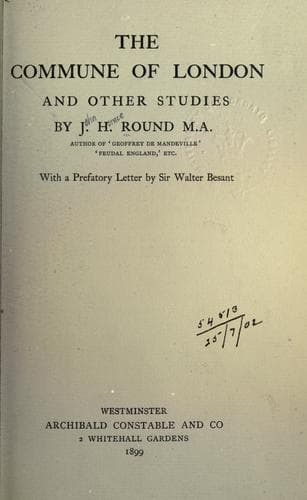
The Commune of London, and other studiesRound, John Horace
History
The Commune of London, and other studies
Round, John Horace
Great Britain -- History -- Norman period, 1066-1154; London (England) -- History -- To 1500
In the valuable register formerly belonging to the Priory
of Merton ... a similar but shorter list is found, with an
interesting description of these services, which will be
presently referred to (p. ccxxxvii.).
The constitutional significance of the tenure itself has not
been perfectly realised. The Merton Register mentioned above
informs us, under the heading “De Wardis Castri Dovorræ,”
that the Conqueror granted the constableship of the castle
there to the Lord of Fienes, with the service of fifty-six
knights, who kept guard each month in turn, some four or
five at once. Besides these, other knights were assigned
to that constableship, for so many weeks in the year, by
the neighbouring Lords of Chilham and Folkestone, and other
barons mentioned in the later returns. Thus the Castle-ward
was performed down to the reign of John, when it was thought
advisable that such an important fortress should be committed to
the keeping of a royal constable and a permanent garrison....
Hubert de Burgh was appointed constable during pleasure, and the
office has continued to the present day in the patronage of the
Crown (p. ccxxxviii.).
[NOTE.] William de Fesnes, the last baronial Constable,
appears to have received the honour of Wendover by way of
compensation (‘Testa,’ ii. 158).
Now, how much truth is there in this story? Fifty-six knights, we see,
are assigned to John de Fiennes, as first Constable, and fifty-six
knights’ fees (plus or minus 1/10 fee) are assigned in the ‘Liber
Rubeus’ to the “Warda Constabularii.” But the history of these fees,
the “Honor Constabularii,” can be traced with absolute certainty. They
are those which had last been held by Henry de Essex, “the Constable,”
whose tragic fate is familiar, which had been previously held by Robert
de Ver “the Constable,” in right of his wife, a Montfort, and the
possession of which can be traced back by Domesday to no other than
Hugh de Montfort.[568] We learn then that “the Honour of the Constable”
(which we should not otherwise have known) was connected with the
custody of Dover Castle, the “clavis et repagulum Angliæ”; and we learn
more. For when we turn to the story of the attack on Dover Castle
in 1067, we find Hugh de Montfort “the immediate commander of the
castle”;[569] and are thus able to trace the “Warda Constabularii” back
to the Conquest itself.
Thus the legend of John de Fiennes and his heirs, constables of the
castle, together with its “constitutional significance,” is blown, as
it were, into space, and should never, henceforth, be heard.
Public-domain text, read in full here on John Shaqi.
Reviews
Reviews
No reviews yet
Be the first to share your thoughts on this work.
Elsewhere in the archive
Join the Discussion
Join the discussion
Sign in to leave a comment or review.
Sign InorCreate an account