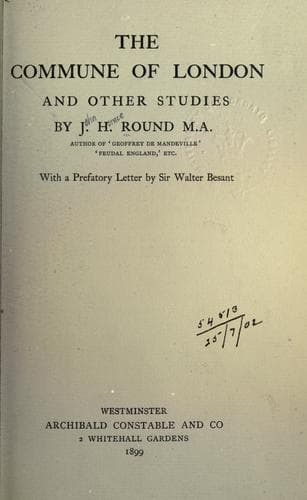
The Commune of London, and other studiesRound, John Horace
History
The Commune of London, and other studies
Round, John Horace
Great Britain -- History -- Norman period, 1066-1154; London (England) -- History -- To 1500
The “Honour of the Constable” passed to the Crown on the forfeiture
of Henry of Essex (1163); and as for the alleged action of “James
Fienes” as constable in 1191, it is well known that the constable at
the time was a brother-in-law of Longchamp, the king’s representative.
I have suggested in a paper on “Faramus of Boulogne”[570] a possible
origin for the Fiennes story in the castle being held by Faramus
at the close of Stephen’s reign, a fact which may account for the
late tradition about “quodam comite Boloniæ qui erat ejusdem Castri
Constabularius.”[571] For the Fienes family were his heirs, through his
daughter; and it was through him, and not on the ground suggested by
Mr. Hall, that they obtained Wendover. To Faramus himself, however, it
may have been given in compensation.
* * * * *
Thus far I have been dealing with a question of castle-ward. I now pass
to the ‘cornage rents’ and to the new theory of their origin. This
theory is one of the features of Mr. Hall’s Introduction, in which he
devotes to it ten pages; and it follows immediately on his remarks upon
“the constableship of Dover.”
As difficult a subject as ‘Scutage,’ and one on which less has been
written, the origin and character of “cornage” are problems as yet
unsolved. The brilliant pen of Professor Maitland has attacked them in
a paper on “Northumbrian tenures”;[572] but he cannot tell us more,
virtually, than we know already, namely, that the term points to
cattle, and is not derived, as Littleton in his ‘Tenures’ and the older
antiquaries held, from the service of blowing a horn.
Mr. Hall, however, “hazards” the new and startling theory that the
payment known by this name represents a commutation of castle-ward
previously due from the drengs and thegns of the Northern marches. For
this, it would seem, his only ground is the entry in the ‘Red Book’ of
a list of Northumbrian cornage payments in close proximity to lists of
castle-ward services. On this slender foundation is built an edifice
of guesses, such as distinguishes this strange work from any other in
the Rolls Series. They are prefaced, in their order, as usual, thus:
if we might venture to disregard ... we may suspect that ... the
impression remains that ... May we not then conjecture that ...
it will now be possible to hazard some theory ... It is at least
conceivable that ... will perhaps suggest the theory, etc.,
etc.... (pp. ccxlii.-ccxlviii.).
Public-domain text, read in full here on John Shaqi.
Reviews
Reviews
No reviews yet
Be the first to share your thoughts on this work.
Elsewhere in the archive
Join the Discussion
Join the discussion
Sign in to leave a comment or review.
Sign InorCreate an account