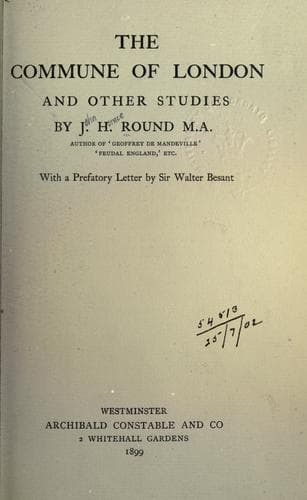
The Commune of London, and other studiesRound, John Horace
History
The Commune of London, and other studies
Round, John Horace
Great Britain -- History -- Norman period, 1066-1154; London (England) -- History -- To 1500
In each succeeding year-roll, from the beginning of the reign of
Henry II., the sheriff of Cumberland had rendered his account
for the Neatgild of the county. The amount of this tribute was
fixed at £80.... But we have no means of showing how the £80 was
made up, because the sheriff answered for it in a lump sum, and
no particulars of his account have survived as in the case of
the Northumberland list happily preserved in the Red Book.
But this Neatgild (or cornage) can be traced back much further, namely,
to the year-roll of 1130, and even earlier. It was £85 8_s._ 8_d._
under Henry I., and over £80 under Henry II.; and details of sums
paid in respect of it are duly found, not only in the ‘Red Book’ (pp.
493–4),[574] but also in the ‘Testa de Nevill.’ Moreover, the cornage
of Northumberland as well was answered for “in a lump sum,” and this
leads me to explain the entry of the Northumbrian lists. Mr. Hall has
failed to observe that his manuscript adds up the cornage wrongly, and
is even guilty of a further error in asserting that this erroneous
total is “xxii den. plus quam alii solebant respondere,” its real
excess being £1 1_s._ 10_d._[575] Apart from its obvious bearing on the
character and value of the manuscript, this error has misled the editor
into stating that the sums entered, “less the pardons of the Prior
of Tynemouth and the King of Scots, make up the charge of £20 for the
county.” On the contrary, the grand total is £21 3_s._ 10_d._, although
the sheriffs were only liable for the “lump sum” of £20. Why is this?
It is because Robert “de Insula,” to whom we owe the list, held the
shire “ut custos.” This most important Exchequer phrase, which the
editor must have overlooked on the roll, can be traced back, at least,
as far as 1130. It means that the Crown had put its own man in office,
and was thus able to get at the details of the payment, for which
the normal sheriff was only liable in a “lump sum.” This is why the
opportunity was taken to set these details on record. This explanation
applies also to the details of Newcastle ward service immediately
preceding the cornage payments. The editor might have learnt from the
Pipe Rolls that the sheriff was normally charged, in respect of this
payment, with £32 4_s._ 5_d._ gross, and £28 14_s._ 5_d._ net, which
latter sum he was entitled to retain for his wardenship of the castle.
But Robert, as “custos,” recorded the receipts as amounting to £33, and
was consequently called upon in 1267 to account for £4 5_s._ 7_d._(the
difference between £33 and £28 14_s._ 5_d._) “de cremento wardarum
Novi Castri de anno xlix° sicut recepit.” The entry, therefore, of
both lists can be traced to Robert’s position “ut custos” in 49 Hen.
III. Lastly, the statement that “the cornage of Westmoreland can also
be traced on the rolls, but it was of very trifling value,” seems
unfortunate in view of the fact that it was, when it first appears,
Public-domain text, read in full here on John Shaqi.
Reviews
Reviews
No reviews yet
Be the first to share your thoughts on this work.
Elsewhere in the archive
Join the Discussion
Join the discussion
Sign in to leave a comment or review.
Sign InorCreate an account