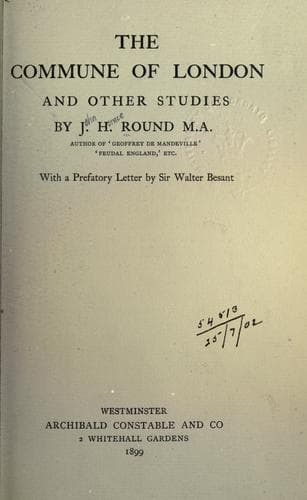
The Commune of London, and other studiesRound, John Horace
History
The Commune of London, and other studies
Round, John Horace
Great Britain -- History -- Norman period, 1066-1154; London (England) -- History -- To 1500
nearly thrice as large as the whole cornage of Northumberland.
That I may not close with a negative result, I append two remarkable
charters from the MS. cartulary of St. Bees, which show us the Cumbrian
Noutegeld being actually paid in cows to William earl of Albemarle,
as lord of Coupland, which barony was exempt from its payment to the
Crown.[576]
Willelmus comes Albemarlie archiepiscopo Ebor[acensi] et
capitulo et omnibus matricis ecclesie filiis salutem. Noverit
paternitas vestra me dedisse et concessisse deo et sancte Marie
et sancte Bege in Copelandia et omnibus (_sic_) vi vaccas
in perpetuam elemosinam reddendas anno omni quo meum Noutegeld
debuerit fieri. Hanc autem donacionem feci pro animabus omnium
antecessorum meorum et antecessorum uxoris mee Cecilie.
Testibus, etc....
* * * * *
Willelmus comes Albemarlie omnibus hominibus suis tam futuris
quam presentibus salutem. Sciatis quod dedi et presenti carta
confirmavi Deo et sancte Marie et sancte Bege et monachis de
sancta Bega vi vaccas de meo Nautegeld (_sic_) unoquoque anno,
quando accipio Nautegeld in Copuland, etc.[577] ...
Now it is a most interesting fact that in Durham also we find, as in
Coupland, a payment in cows (“vaccas de metride”) made by townships
in connection with their payment of “cornage.”[578] From the above
important charters, it would seem that the two dues went together.
In Durham there is a classical passage for the “cornage” proper,
quoted by those who have dealt with “cornage,” but not by Mr. Hall.
In a charter of Henry I., which I assign to 1128–9, he speaks of
“cornagium de Bortona ... _scilicet de unoquoque animali_ ij _d._”[579]
This is precisely the source of “cornage” which Mr. Hall desires to
“disregard.” And if further proof were needed of the non-identity
of “cornage” with castle-ward, it is found in the fact that, as in
Northumberland, both dues existed simultaneously in Durham, vills
which paid cornage being also liable to provide men for castle-ward
(“castlemanni”).[580]
XIV
Bannockburn
Public-domain text, read in full here on John Shaqi.
Reviews
Reviews
No reviews yet
Be the first to share your thoughts on this work.
Elsewhere in the archive
Join the Discussion
Join the discussion
Sign in to leave a comment or review.
Sign InorCreate an account