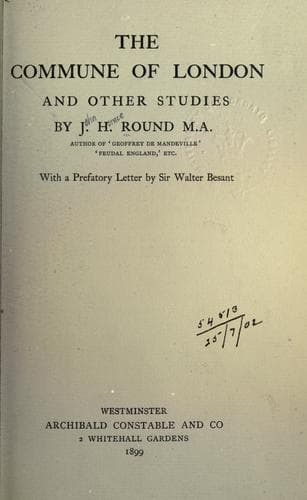
The Commune of London, and other studiesRound, John Horace
History
The Commune of London, and other studies
Round, John Horace
Great Britain -- History -- Norman period, 1066-1154; London (England) -- History -- To 1500
When Edward III. arrayed his host, twenty-five years later, for
the French war, he only asked for 500 foot from Northumberland (as
against 2,500), and 1,000 from Yorkshire, but from Warwickshire with
Leicestershire he exacted 480. These figures speak for themselves.
Any one of ordinary intelligence can see that the forces on these two
occasions were raised on entirely different principles, Northumberland
being called on for five times as many men in 1314 as in 1339, while
Warwickshire and Leicester supplied almost as many in the latter as
in the former year. And yet Mr. Oman actually makes the comparison
himself (p. 593), and prints the numbers in detail for both occasions
without any comprehension that this was so. Indeed, he bases on his
misapprehension a theory that as, at the later date (1339), the quotas
were never more than a third of those demanded for Bannockburn (1314),
a comparatively picked force was secured.
We note that the Commissions of Array in the latter year were
directed to levy only from about one-third to one-fifth of
the numbers which the sheriffs had been told to provide in
the former year. They were, of course, individually better in
proportion to the greater care which could be taken in selecting
them.[593]
We have seen that, on the contrary, in Warwickshire and Leicestershire,
the number summoned was almost the same, and that the above theory is,
therefore, another delusion. In 1339 the proportion varied from 20
per cent. to 96 per cent. of the numbers summoned in 1314, and did so,
as we have seen, on a geographical system. Mr. Oman bases his above
assertion on a note in which four lines contain four direct mistakes.
It asserts that Yorkshire sent “six thousand,” Lincolnshire “four
thousand,” Warwick “five hundred,” and Leicester “five hundred,” in
1314, when the right numbers, as given by himself on page 573 of the
same volume, were: Yorkshire _four_ thousand, Lincolnshire _three_
thousand, and Warwick and Leicester _together_ five hundred. The result
of this astounding inaccuracy is that he fails to understand the system
of these levies in the least.
Public-domain text, read in full here on John Shaqi.
Reviews
Reviews
No reviews yet
Be the first to share your thoughts on this work.
Elsewhere in the archive
Join the Discussion
Join the discussion
Sign in to leave a comment or review.
Sign InorCreate an account