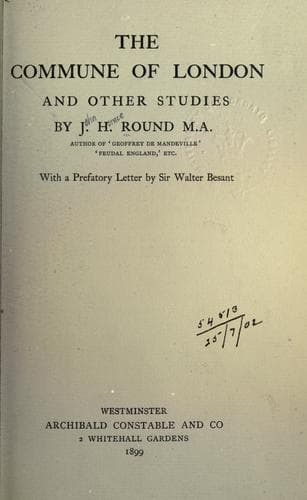
The Commune of London, and other studiesRound, John Horace
History
The Commune of London, and other studies
Round, John Horace
Great Britain -- History -- Norman period, 1066-1154; London (England) -- History -- To 1500
It is, no doubt, surprising that, after years of study, a writer should
produce a work intended to constitute a standard authority on mediæval
warfare, in which he has not even grasped so elementary a fact as
the raising of English armies, in the 14th century, on geographical
principles, and should consequently invent an imaginary host of nearly
30,000 men. Precisely as in 1314, the bulk of the foot for the Scottish
expedition were raised from the Northern counties, so in 1345, for the
contemplated French expedition, it was from the counties south of the
Trent that the infantry (archers) was raised.[594] But it is even more
surprising that he should substitute for this system a theory, based on
the misquotation of his own figures alone, that, in 1339, we meet with
a new system of summoning a comparatively small quota of picked men.
It is but a further instance of his grievous lack of accuracy that on
page 599 he renders the “homines armati”[595] summoned from the towns
as “seventeen hundred archers,” although he prints from Rymer, a few
pages earlier, the numbers of the foot summoned in 1339, of whom half
are distinguished as archers and half as “armati.”
One would have imagined that the fact of the host being drawn from
the northern half of England alone would have been obvious from the
dates. The orders from which Mr. Oman takes the numbers demanded were
only issued from Newminster on May 27,[596] and ordered a rendezvous
of the force at Wark (Northumberland) on June 10. The troops were to
be there on that day “armis competentibus bene muniti, ac prompti et
parati ad proficiscendum” to the immediate relief of Stirling. The time
was desperately short, and haste was enjoined (“exasperes, festines”).
Moreover, the English leaders were clearly not such fools as Mr. Oman
imagines. The “orders” state that foot are wanted because the Scots
nituntur, quantum possint, ... in locis fortibus et morosis (ubi
equitibus difficilis patebit accessus) adinvicem congregare.
Common sense tells one that 60,000 foot could not be manœuvred in such
country, and would only prove an encumbrance. Edward, therefore, only
summoned less than 22,000. As to his horse, Mr. Oman writes: if the
English “had, as is said, three thousand _equites coperti_, men-at-arms
on barded horses, the whole cavalry was probably ten thousand” (p.
575). But why? At Falkirk, sixteen years before, Edward I., he writes
(p. 565), had
the whole feudal levy of England at his back. He brought three
thousand knights on barded horses, and four thousand other
men-at-arms.
Public-domain text, read in full here on John Shaqi.
Reviews
Reviews
No reviews yet
Be the first to share your thoughts on this work.
Elsewhere in the archive
Join the Discussion
Join the discussion
Sign in to leave a comment or review.
Sign InorCreate an account