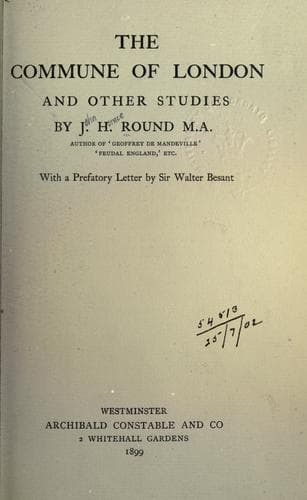
The Commune of London, and other studiesRound, John Horace
History
The Commune of London, and other studies
Round, John Horace
Great Britain -- History -- Norman period, 1066-1154; London (England) -- History -- To 1500
Lastly, on that all-important point, the disposition of the English
archers, we are shown in the first ground plan the “English archers
considerably in advance of the main body,” and, indeed, almost all on
the Scottish side of the burn. In his second they are still in front
of the host, but no longer across the burn. In his third there are no
“archers” shown, and the English ‘battles’ themselves are depicted
as close up to the burn. But to realize the completeness of the
contradiction, one must place side by side these two passages:
His [Edward II.’s] most fatal The worst point of all was
mistake, however, was to place that in each corps the archers
all his archers _in the front had been placed _behind_[603] the
line_,[602] without any horsemen ... condemned from the
protecting body of horsemen first to almost entire
(‘Art of War in the Middle uselessness (‘History of the Art
Ages,’ p. 101). of War,’ p. 575).
Poor Edward! He is first made to place his archers in front of his
horsemen, and blamed for his folly in doing so; and then he is made to
place them behind, and again blamed for his folly.
It is the same with the battle of Creçy (1346). Let any one compare the
four narratives given in succession by Mr. Oman,[604] together with the
three ground plans, and he will be fairly bewildered. The only thing of
which we can be sure is that when Mr. Oman has adopted a view, he will
himself afterwards abandon it. It is the same, again, with the numbers
also. Mr. Oman, in his second narrative (as apparently in his first),
reckons the English host at some 9,300 men (6,000 archers, 2,300
men-at-arms, 1,000 Welsh). In his fourth they exceed 20,000 (11,000
archers, 3,900 men-at-arms, 5,000 or 5,500 Welsh).
Need I pursue further this endless contradiction? It has been my object
to warn the reader of Mr. Oman’s works on the Art of War to compare
his successive views before adopting a single one of them. Whether on
the field of Bannockburn or of Hastings we need a guide who knows, at
least, his own mind, and whose “cocksureness” is not proportionate to
the mutability of his views.
XV
The Marshalship of England
In his valuable essay on a document of which the origin has long been
discussed, the ‘Modus tenendi Parliamentum,’[605] M. Bémont has drawn
attention to the close association of this treatise, in the MSS. which
contain it, with the coronation of Richard II. and with a treatise on
the Marshal’s office. So close, indeed, is this association that
Coke affirme avoir vu de ce traité [the _Modus_] un exemplaire
“écrit au temps de Henri II. qui contient la manière, la forme
et l’usage de Gilbert de Scrogel, maréchal d’Angleterre, et qui
indique comment il s’acquittait alors de son office.”
Public-domain text, read in full here on John Shaqi.
Reviews
Reviews
No reviews yet
Be the first to share your thoughts on this work.
Elsewhere in the archive
Join the Discussion
Join the discussion
Sign in to leave a comment or review.
Sign InorCreate an account