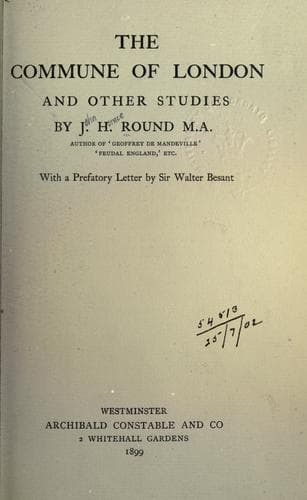
The Commune of London, and other studiesRound, John Horace
History
The Commune of London, and other studies
Round, John Horace
Great Britain -- History -- Norman period, 1066-1154; London (England) -- History -- To 1500
Many very ancient copies you may find of this Modus, one whereof
we have seen in the reign of H. 2, which contains the manner,
forme, and usage of Gilbert de Scrogel, marshall of England, in
what manner he occupied and used the said roome and office in
all his time, and how he was admitted etc. at the coronation of
H. 2 (‘Institutes,’ 4, xxi.).
For the error is only found in the above petition.
Now, it ought to be obvious that no such person as Gilbert Marshal,
earl of ‘Strogoil,’ could have existed in 1154, for the Marshals did
not inherit till a later time that Earldom, which was held in 1154 by
the house of Clare. It has indeed been suggested that for “Gilbert”
we should read “Richard,”[607] but this will not help us. For, to
secure consistency, we should have to read “Richard _de Clare_.”
Nevertheless, it has been loosely assumed, on no other evidence, that
Richard de Clare, earl of Pembroke (“Striguil”) acted as Marshal of
England at the coronation of Henry II. in 1154.[608] And on this
foundation antiquaries have raised theories to which we must return.
The real explanation is perfectly simple. On turning to fo. 86_d._
of the MS. we find an entry “de officio marescalcie,” which we can
positively identify as taken from fo. 232 of the ‘Red Book of the
Exchequer’ (p. 759) where it is found among the “services” at Queen
Eleanor’s coronation in 1236. Then turning back to Countess Margaret’s
claim (fo. 65_d_), we find that it enshrines, in Norman French, this
entry word for word. Therefore the whole error has been caused by
the words “as coronement le Roy Henri second” (1154) applied to an
entry which really related to the coronation of Queen Eleanor (1236)!
“Gilbert Mareschall Conte de Strigoil” had no existence at the former
date, but he actually held the marshal’s rod in 1236.[609]
Camden, it seems, is responsible, in the first instance, for the theory
that the office of “Marshal of England” was distinct in origin and
character from that of Marshal of the Household. Strangely enough,
in his earlier essay,[610] he made no such distinction, but, on the
contrary, stated that Roger Bigod “was he which first stiled himselfe
_marescallus Angliæ_, whereas all his predecessors used noe other
stiles than the simple addition of _marescallus_.” In his second essay
(3rd Nov., 1603)[611] he gave a list of the “Marshals of England,”
deducing the office from a grant of Stephen, who “made Gilbert Clare
earl of Pembroke and Marshal of England, with the state of inheritance,
who ... was commonly called earl of Stryghall.” Thus arose the whole
theory which Thoms, following Camden, adopts in his ‘Book of the Court’
(pp. 241, 244), namely, that the two offices were accidentally united
by the marriage of William (the) Marshal (of the Household) with
Isabel, heiress of the earls of Pembroke, “Marshals of England.”
Public-domain text, read in full here on John Shaqi.
Reviews
Reviews
No reviews yet
Be the first to share your thoughts on this work.
Elsewhere in the archive
Join the Discussion
Join the discussion
Sign in to leave a comment or review.
Sign InorCreate an account