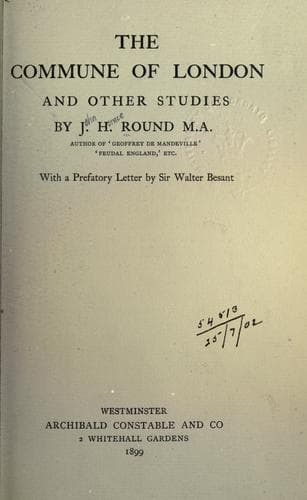
The Commune of London, and other studiesRound, John Horace
History
The Commune of London, and other studies
Round, John Horace
Great Britain -- History -- Norman period, 1066-1154; London (England) -- History -- To 1500
From Thoms this theory has found its way into the ‘Complete Peerage.’
I need not here say more than that I have carefully examined the
evidence, and that, after the alleged union of the offices, there is
no trace of their being granted as more than one. When John confirmed
(20th April, 1200) the marshalship to William Marshall, it was as
magistratum maresc’ curie nostre quam magistratum Gillebertus
Marescallus Henrici Regis avi patris nostri et Johannes filius
ipsius Gilleberti disrationaverat coram predicto Rege Henrico in
curia sua.[612]
And when William’s younger son Gilbert obtained it from Henry III.,
after his brother’s death, we read of the king (11th June, 1234)--
Tradens ei virgam marescalcie curie sue sicut moris est et sicut
eam antecessores ejus melius et liberius habuerunt.[613]
It would not be in place here to discuss the growth of the office with
the growth of the administration, just as the constableship developed
in its descent from Miles of Gloucester through the Bohuns. The one
point to keep in mind is that the office of marshal descended from
Gilbert _temp._ Hen. I., to Roger Bigod, earl of Norfolk, at whose
death in December (1306), the marshalship, by his own arrangement,
reverted to the king.
It was the king’s intention to bestow it on his young son Thomas
“of Brotherton”; but as he was at the time only six years old, it
was given, ‘during pleasure,’ 3rd September, 1307, to Robert de
Clifford,[614] and, a few months later, to Nicholas de Segrave (12th
March, 1308), also ‘during pleasure.’[615] These appointments are
important for their bearing on a note by Dr. Stubbs that
William le Mareschal had served as marshall at the coronation,
but was superseded in 1308 by Nicholas Segrave, with whom he
went to war in 1311. It was probably his dismissal that offended
Lancaster in 1308; see ‘M. Malmesb.,’ p. 103; and he may be
considered as a strong adherent of the earl (of Lancaster).[616]
It is the case that William Marshall had carried the great gilt spurs
at the coronation of Edward II. (Feb., 1308), but we do not find his
name on the Patent Rolls among the appointments to the “Marshalsea
of England.” He can, therefore, only have been chosen to act at the
coronation, and was doubtless selected, in preference to the temporary
Marshal, as being hereditary Marshal of Ireland. Summoned to Parliament
as a baron in 1309, he became one of the ‘Ordainers’ in 1310.
Robert de Clifford, whom Segrave replaced, was afterwards concerned in
Gaveston’s death (or, at least, pardoned as being so),[617] but was
clearly a strong supporter of the king at the beginning of 1308. And as
appointments and favours were bestowed upon him for two or three years
afterwards, one cannot think that he was out of favour, or that he
can be alluded to in the passage cited by Dr. Stubbs from the Monk of
Malmesbury:
Public-domain text, read in full here on John Shaqi.
Reviews
Reviews
No reviews yet
Be the first to share your thoughts on this work.
Elsewhere in the archive
Join the Discussion
Join the discussion
Sign in to leave a comment or review.
Sign InorCreate an account