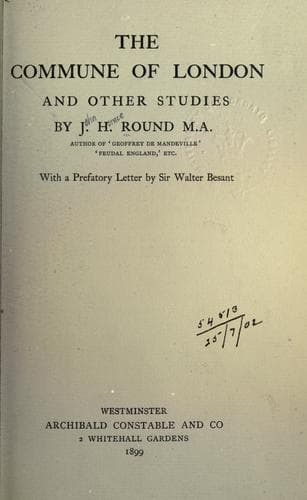
The Commune of London, and other studiesRound, John Horace
History
The Commune of London, and other studies
Round, John Horace
Great Britain -- History -- Norman period, 1066-1154; London (England) -- History -- To 1500
This makes perfect sense, giving as it does the descent of the Honour
from Walter Fitz Richard (de Clare), founder of Tintern. But a much
later hand (? 17th century) has coolly run a pen through the three
words I have italicised, thus making nonsense of the passage, which was
then, in this mutilated form, printed by Dugdale! It is but a further
instance of the havoc which he and others have wrought in the genealogy
of the famous house of Clare.
As this charter is of independent value for its early (apparently
earliest)[626] mention of the name ‘Strongbow,’ its date is of
importance; Mr. Archer states that it is “dated Strigul, 22nd March,
1206,”[627] an obviously impossible date. Its real date was 22nd March,
1223[628] (7 Hen. III.).
We may now return to the office of Marshal in the 14th century. On June
3, 1317, the king called on the barons of the Exchequer to inform him
from their records, “quæ et cujusmodi feoda marescalli Angliæ qui pro
tempore fuerunt et eorum ministri temporibus progenitorum nostrorum
videlicet de pane, vino, cereolis, et candelis percipere et habere
consueverunt.” For reply they sent him the relative extract from the
“Constitutio domus regis.”[629] In 4 Edward III., “Thomas counte
Norfolk et marshall d’Engleterre” petitioned the king for his fees “qui
appendent a son office de la marechausie dedeinz l’ostell et dehors
auxi, come ses predecesseurs countes mareschauls ount estre servy”;
and he annexed a list of them based on the above return.[630] Again,
on April 13, 1344, the king called on the Exchequer for a return from
its records “de feodis quam de aliis quibuscunque quæ pertinent ad
officium comitis marescalli et mariscalciæ Angliæ,” etc., etc. Again
they sent him the relative extract “in quadam constitutione de domo
regis antiquitus facta”; but they added the passage “in Rubro Libro
Scaccarii” on Queen Eleanor’s coronation (1236), and a ‘Dialogus’
passage on the fees due to the Marshal from those he imprisoned for
default at the Exchequer.[631]
Lastly, we have in the treatise on the Marshal’s office, as given in
Nero D. vi., the following passage at its close (fol. 86_d_):
In rubro libro de scaccario Regis folio xxx^o sic continetur de
marescallo.
Et preter hoc debet magister marescalcie habere dicas de donis
et liberacionibus que fuerint de Thesauro Regis et de sua
camera et debet habere dicas contra omnes officiales Regis ut
testis per omnia. Quatuor marescalli qui serviunt familie Regis
tam clericis quam militibus quam ministris die qua faciunt
herbergeriam vel extra curiam in negocio Regis morantibus, viij
d. in die et galonem vini expens’ et xij frustra candelarum si
extra tres de die in diem homini suo et cand’ plenar’ quod si
aliquis marescallorum missus fuerit in negocio Regis viij d.
ta[ntu]m servientes Marescallorum si fuerint missi in negocio
Regis unusquisque in die iij d. sin autem in domo Regis comedent.
* * * * *
Public-domain text, read in full here on John Shaqi.
Reviews
Reviews
No reviews yet
Be the first to share your thoughts on this work.
Elsewhere in the archive
Join the Discussion
Join the discussion
Sign in to leave a comment or review.
Sign InorCreate an account