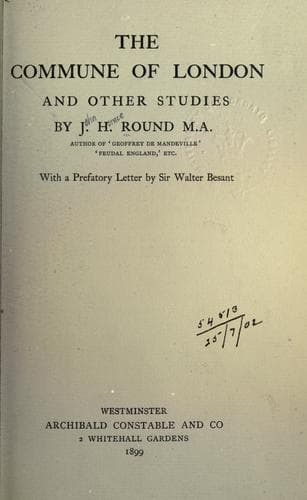
The Commune of London, and other studiesRound, John Horace
History
The Commune of London, and other studies
Round, John Horace
Great Britain -- History -- Norman period, 1066-1154; London (England) -- History -- To 1500
(1309) unde magnates terræ cœperunt hæc pro malo habere et
præcipue comes Lancastriæ, quia unus ex familiaribus suis,
procurante Petro, ejectus erat ab officio suo.[618]
It could not in any case apply, as Dr. Stubbs suggests, to William le
Mareschal. Professor Tout not only dates Segrave’s appointment a year
too late, but goes so far as to say that, against him,--
William Marshal, a peer of Parliament and a collateral
representative of the great Marshal family, claimed the office
as devolving on him by hereditary right.[619]
It is obvious that the only person who could make such a claim was the
disinherited brother of the late earl of Norfolk.
On February 10, 1316, the Marshalship of England became once more an
hereditary office, being bestowed on Thomas ‘de Brotherton,’ then earl
of Norfolk, and the heirs male of his body.[620]
Let me here again insist that the fundamental error has been the
anachronism interpolated in Countess Margaret’s coronation claim
(1377). This is really the sole foundation for the statement that the
Clares earls of Pembroke held the office of Marshal of England; and it
can be conclusively shown to arise from mistaking the coronation of
1236 for that of 1154.[621]
Having thus traced to its origin the confusion which made Richard
Strongbow and his father Gilbert marshals of England, I may now deal
with the further confusion which assigns to Richard ‘Strongbow’ a
legitimate son Walter. In Ormerod’s ‘Strigulensia’ (p. 63), in Mr.
Archer’s biography of Richard,[622] and now in the ‘Complete Peerage,’
the fact is accepted as certain. The authority for this statement is a
Tintern Abbey charter, in which William Marshal the younger confirms
certain grants (22nd March, 1223)--
pro animabus bone memorie Walteri filii Ricardi filii Gilberti
Strongbow avi mei, et Willelmi Marescalli patris mei, et
Ysabelle matris mee (‘Mon. Ang.,’ v. 267).
A very able genealogist, Mr. G. W. Watson, holds that this charter
makes the existence of a son Walter “certain.”[623] But as the text
appeared to me obviously corrupt, I referred to the Arundel MS.,[624]
from which it is printed in the ‘Monasticon.’ I there made the
startling discovery that, as I thought possible, the true text is this
(in a 15th century transcript of a 14th century _inspeximus_ of the
13th century charter):
pro animabus bone memorie Walteri filii _Ricardi_, _Gilberti
Strongbowe_, Ricardi filii Gilberti Strongbowe avi mei, et
Willelmi Marescalli patris mei et Ysabelle matris mee[625] (fo.
1).
Public-domain text, read in full here on John Shaqi.
Reviews
Reviews
No reviews yet
Be the first to share your thoughts on this work.
Elsewhere in the archive
Join the Discussion
Join the discussion
Sign in to leave a comment or review.
Sign InorCreate an account