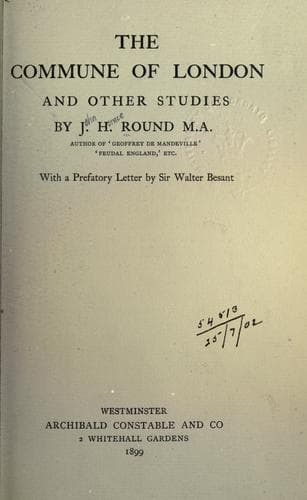
The Commune of London, and other studiesRound, John Horace
History
The Commune of London, and other studies
Round, John Horace
Great Britain -- History -- Norman period, 1066-1154; London (England) -- History -- To 1500
There is a transcript in Nero D. vi., with a beautifully illuminated
initial, of the patent by which Richard II. created Thomas Mowbray earl
of Nottingham Marshal of England and Earl Marshal (12th Jan., 1386),
in tail male. Here again the confusion has been terrible. The Record
Commission’s Catalogue of the Cottonian MSS. describes it as “Literæ R.
Ricardi II. constituentes Tho. _de Brotherton_, com. Nottingham,[638]
Marescallum Angliæ A^o. 1386,” and it is this doubtless, which has
led several writers into grave error, down to M. Bémont, who enters
the document as “les lettres patentes de Richard II. instituant Thomas
de Brotherton maréchal d’Angleterre” (p. 472). But, for my purpose,
the important point is that this is the first grant of the office of
“_Earl_ Marshal.” On the one hand, a high authority asserts in the
‘Dictionary of National Biography’ that Roger Bigod, earl of Norfolk,
received “the office of Earl Marshal” in 1246; on the other, we read
in the ‘Complete Peerage’ that an “_Earl_ Marshal” was first created
in 1397.[639] Neither statement is correct. On June 30, 1385, Richard
bestowed on the earl of Nottingham “the office of Marshal of England,”
which we have traced above.[640] Dugdale, citing the record below,
wrongly states that Thomas was “constituted _Earl_ Marshal of England”
for life on this occasion, and is followed in this by Professor
Tout.[641] Thomas certainly styled himself “Earl Marshal and of
Nottingham” in the month following, but this was one of the assumptions
of the time. He was only so created by the patent which follows. It is
desirable, therefore, to give here the exact wording of the grant:
Sciatis quod cum nos nuper de gracia nostra speciali
concesserimus dilecto consanguineo nostro Thome comiti
Notyngh’ officium marescalli Anglie ad totam vitam suam, Nos
jam de uberiori gratia nostra concessimus prefato consanguineo
nostro officium predictum una cum nomine et honore comitis
Marescalli habend’ sibi et heredibus suis masculis de corpore
suo exeuntibus cum omnimodis feodis proficuis et pertinenciis
quibuscunque dicto officio qualitercunque spectantibus.
This grant, which is dated at Westminster, 12th January, 1386 (9 Ric.
II.), is, oddly enough, unknown even to experts. Dugdale had missed it,
and it is consequently ignored in Wallon’s ‘Richard II.,’ in Professor
Tout’s biography of Nottingham,[642] and in the ‘Complete Peerage.’
It illustrates not only the high favour in which Nottingham still
stood, but the _entourage_ of the king at the time, which included
several of those about to lead the opposition.[643]
The above grant is duly referred to in the so-called creation of
February 10, 1397. This is headed in the Rolls of Parliament:
Une chartre du Roy faite a le Conte Mareschall touchant son
Office de Mareschall d’Engleterre....
Public-domain text, read in full here on John Shaqi.
Reviews
Reviews
No reviews yet
Be the first to share your thoughts on this work.
Elsewhere in the archive
Join the Discussion
Join the discussion
Sign in to leave a comment or review.
Sign InorCreate an account