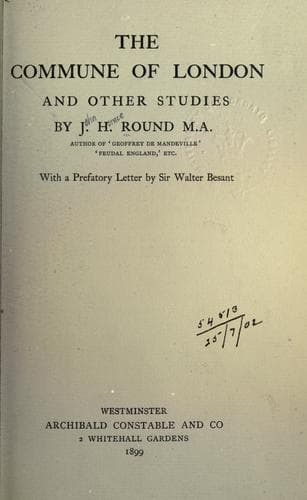
The Commune of London, and other studiesRound, John Horace
History
The Commune of London, and other studies
Round, John Horace
Great Britain -- History -- Norman period, 1066-1154; London (England) -- History -- To 1500
Sciatis quod cum nuper per literas nostras patentes de gratia
nostra speciali concesserimus dilecto consanguineo nostro Thome
Comiti Notyngh’ Officium Marescalli Anglie, una cum nomine et
honore Comitis Marescalli, habendum sibi et heredibus suis
masculis, etc.... Nos.... volentes proinde pro statu et honore
ipsius Comitis uberius providere, de gratia nostra speciali, in
presenti Parliamento nostro concessimus pro Nobis et heredibus
nostris eidem Comiti dictum officium ac nomen, titulum, et
honorem Comitis Marescalli Anglie habendum sibi et heredibus
suis masculis, etc. (Then follow additional concessions.)
The transition, in the marshal’s style, is interesting enough. First we
have “the Marshal,” or rather “the Master Marshal”; then “the Marshal
of England,” as a more high-sounding style; next a confusion due to the
fact that the Marshals also held an earldom through the 13th century,
and so became, in common parlance (though not in strictness), “Earls
Marshall”; lastly, even so early, we have seen,[644] as 1344, there
occurs the cumbrous and unmeaning phrase “officium comitis marescalli
et mariscalciæ Angliæ.” Proving, though it does, the rapid accretion
of error and confusion in the Middle Ages, the double style obtained
recognition in the Patent of 1386.[645] It is singular that, even
at the present day, the “Peerages” style the duke of Norfolk “Earl
Marshal and hereditary marshal of England,” although he is simply “Earl
Marshal” under the creation of 1672.[646]
An apology is hardly needed for introducing here a characteristic
challenge, addressed by the young Earl Marshal in the chivalrous spirit
of the time, “a noble et honnore S^r le conte de Soissons sire de
Coucy.” This quaint epistle begins thus:
Honure S^r Pour ce que vous estez homme donneur approue de
vaillance et de chevalerie et de grant renomee comme bien est
cogneu es plusieurs lieux honnorables, et je suis joesne,
etc.... Je envoie devers vous Notynghant mon heraut, etc.
Then follow the terms of the challenge:
et apres les trois cops de lance, trois pointes despee, trois
pointes de dague, et trois cops de hache a pie.
Every precaution would seem to be taken against the survival of either
combatant. The letter closes with due formality:
Escript a Londres le x^o jour de Janvier lan de grace mille ccc
iiii^{x(x)} et neuf selon le compte de leglise d’Angleterre.
* * * * *
Par le conte Mareschall’ et de Notyngham S^r de Moubray et de
Segrave mareschall’ d’Angleterre.
This document, I believe, has not hitherto been known.
* * * * *
And now, when we turn to the ‘Modus,’ we find in the chapter treating
“De Casibus et Judiciis difficilibus” a startling statement that, if
difficulties arose,--
Public-domain text, read in full here on John Shaqi.
Reviews
Reviews
No reviews yet
Be the first to share your thoughts on this work.
Elsewhere in the archive
Join the Discussion
Join the discussion
Sign in to leave a comment or review.
Sign InorCreate an account