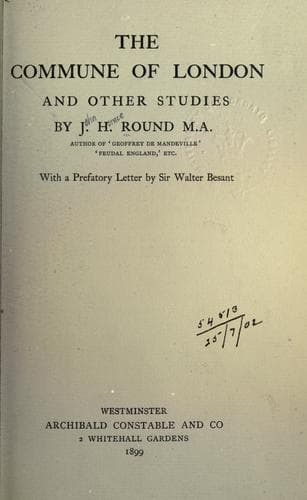
The Commune of London, and other studiesRound, John Horace
History
The Commune of London, and other studies
Round, John Horace
Great Britain -- History -- Norman period, 1066-1154; London (England) -- History -- To 1500
tunc comes senescallus, comes constabularius, _comes
marescallus_, vel duo eorum, eligent viginti quinque personas de
omnibus paribus regni, etc., etc.
It need scarcely be said that no such right belonged _ex officio_ to
these three magnates, or was even claimed by them. Yet no one has
suggested, so far as I know, that there must have been a reason for
inserting this clause, and that in such reason we may find a note
of time. Ordainers were elected, under Edward II., in 1310, and a
Commission under Richard II. in 1386. No one, it is certain, could have
introduced the reference to an “Earl Marshal” in 1310, for Thomas,
future marshal of England; was then only a boy of ten. But in 1386
there was, in Nottingham, an Earl Marshal, and one who was, at the
time, taking a leading part. Indeed the three chiefs of the opposition
at the time were Gloucester, Derby, and Nottingham, who respectively
represented the Constable, the Steward,[647] and the Marshal. Add to
this that it was in the Parliament of 1386 that we find the precedent
of Edward II. prominent in the minds of men,[648] and that it was also
in this Parliament that appeal was made to a supposed statute, and that
the ‘Modus’ contains a chapter “De Absentia regis in Parliamento” (a
grievance in 1386), and we have at least a fair presumption that the
‘Modus’--at any rate in the form that has reached us--dates from the
constitutional crisis of 1386.[649]
I shall now close this article, which has already exceeded its original
limits, with a document hitherto unknown, I believe, to English
historians. The Rolls of Parliament preserve, in the proceedings of
1397 against Gloucester, the appeal of treason presented to the king by
the nobles of his party at Nottingham (5th Aug., 1395). But that appeal
is not known to us at first hand. I believe that I have found the terms
of the document, which correspond, it will be seen, with the printed
version. But instead of closing with the words “soit enterment quasse
et adnulle,” as in the Rolls of Parliament (iii. 341), it proceeds:
laquelle bille nous le prouuerons pour vray avec laide de Dieu
et de sa benoiste mere tant comme la vie nous dure.
Then follows, in parallel columns, the interesting portion of the
document, namely, the five articles of accusation, which are, it
will be found, largely different and much shorter than on the Rolls.
Opposite them is a notable confession which, from evidence it contains,
I assign to the duke of Gloucester.
Public-domain text, read in full here on John Shaqi.
Reviews
Reviews
No reviews yet
Be the first to share your thoughts on this work.
Elsewhere in the archive
Join the Discussion
Join the discussion
Sign in to leave a comment or review.
Sign InorCreate an account