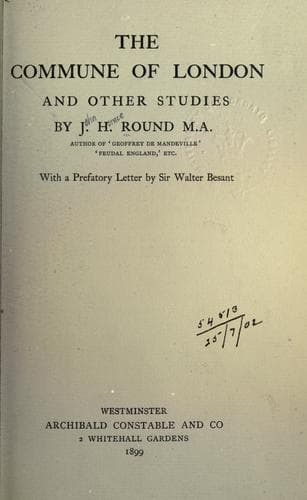
The Commune of London, and other studiesRound, John Horace
History
The Commune of London, and other studies
Round, John Horace
Great Britain -- History -- Norman period, 1066-1154; London (England) -- History -- To 1500
“Not the least of Mr. Round’s merits is that the next generation will
never want to know how much rubbish he has swept or helped to sweep
away. He has done more than any one scholar to put us in the way of
reading Domesday Book aright. He has illustrated by abundant examples
the wisdom and the necessity of ... patient study of our documents, ...
his acute and ever watchful criticism.”--SIR F. POLLOCK in
_English Historical Review_.
“In _Feudal England_ as in _Geoffrey de Mandeville_ he displays
consummate skill in the critical study of records, and uses the
evidence thus obtained to check and supplement the chroniclers.”--DR.
GROSS in _American Historical Review_.
“Plein de faits, d’observations pénétrantes, de conclusions neuves et
de grande portée, ... il a réussi à rétablir la logique où, avant lui,
on ne trouvait que confusion.”--_Revue Historique._
FOOTNOTES:
[1] Speech in the House of Commons (_Times_, 6th June, 1899).
[2] It is important to observe that the Pope’s letter of 20th
September, 1172, contains an unmistakable reference to the (forged)
Donation of Constantine in the words “Romana ecclesia aliud jus habet
in Insula quam in terra magna te continua” (see p. 197 below). Dr.
Zinkeisen, in his paper on “the Donation of Constantine as applied
by the Roman Church,” speaks of this letter as “a genuine bull of
Alexander III.” (‘English Historical Review,’ ix. 629), but strangely
overlooks the allusion, and asserts that he could find no use made by
the Popes of the forged Donation at this period.
[3] See Mr. Scargill-Bird’s ‘Guide to the Public Records.’
[4] ‘Feudal Aids’ (Calendars of State Papers, etc.), vol. i., pp.
ix.-xi.
[5] Director of the Royal Historical Society; Lecturer on Palæography
and Diplomatic at the London School of Economics, etc., etc.
[6] See pp. 131, 135, 283, etc., and Index.
[7] “The surrender of the Isle of Wight” (in ‘Genealogical Magazine,’
vol. i., p. 1) and “The Red Book of the Exchequer” (in ‘Genealogist,’
July, 1897).
[8] January, 1899 (xiv. 150–151). The first paper in my treatise deals
with “the antiquity of scutage,” and contains further evidence for my
contention that, contrary to the accepted view, this important tax
was levied before the days of Henry II. Mr. Hall replied that it was
“curious to find” me seriously citing “forgeries,” the evidence of
which he ridiculed, without deigning to discuss them.
The “most conclusive document” (as I termed it) which I cited in my
favour is a charter of the time of Stephen, which I printed in full
in my treatise (pp. 8–9). Of this I need scarcely say more than that
the authorities of the British Museum have now selected it for special
exhibition among the most interesting of their charters, and have drawn
particular attention to its important mention of scutage (see the
official guide to the MSS., p. 40).
Public-domain text, read in full here on John Shaqi.
Reviews
Reviews
No reviews yet
Be the first to share your thoughts on this work.
Elsewhere in the archive
Join the Discussion
Join the discussion
Sign in to leave a comment or review.
Sign InorCreate an account