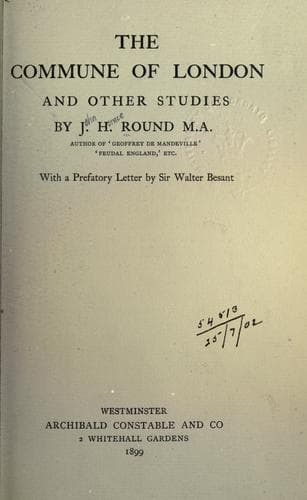
The Commune of London, and other studiesRound, John Horace
History
The Commune of London, and other studies
Round, John Horace
Great Britain -- History -- Norman period, 1066-1154; London (England) -- History -- To 1500
The value of Mr. Hall’s assertions, and the futility of his attempted
reply, could hardly be more effectively exposed. I may add that I
have still a few copies of my treatise available for presentation to
libraries used by scholars.
[9] See Index.
[10] Archæological Review, iv. 235.
[11] Prefixed to the Domesday volume published by the Sussex
Archæological Society.
[12] A generation later than Domesday we find lands at Broadhurst (in
Horsted Keynes) given to Lewes Priory, which “usque ad modernum tempus
silve fuerunt” (Cott. MS. Nero c. iii. fo. 217).
[13] Anglo-Saxon Britain, p. 30.
[14] Ibid. Dr. Guest suggested of Ælle, at the battle of Mercred’s Burn
(485), that “on this occasion he may have met Ambrosius and a national
army; for Huntingdon tells us that the ‘reges et tyranni Brittanum’
were his opponents.” But if the Saxon advance was eastwards, it could
not well have brought them face to face with the main force of the
Britons.
[15] English Village Community, pp. 126, 127, etc.
[16] Social England, i. 122 _et seq._
[17] 2nd ed. p. 178.
[18] English Village Community, pp. 169, 170.
[19] He writes, of _ing_, that “Mr. Kemble had overlooked no less than
47 names in Kent, 38 in Sussex, and 34 in Essex” (ed. 1888, p. 82).
[20] The Lewes Priory Charters afford instances in point.
[21] Archæological Review, iv. 233 _et seq._
[22] One would like to know on what ground the suffix “-well,” familiar
in Essex (Broadwell, Chadwell, Hawkwell, Netteswell, Prittlewell,
Ridgwell, Roxwell, Runwell), but curiously absent in Sussex, is derived
from the Roman ‘villa.’ It is found in Domesday precisely the same
as at the present day. Yet Professor Earle writes of “Wilburgewella”
that it is “an interesting name as showing the naturalized form of the
Latin _villa_, of which the ordinary Saxon equivalent was _haga_” (Land
Charters, p. 130). This latter equation seems to be most surprising. It
is traceable apparently to a charter of 855, in which we read of “unam
villam quod nos Saxonice ‘an hagan’ dicimus” (Ib. p. 336), an obviously
suspicious phrase. There is no ground for terming the ‘Ceolmundinge
haga’ of a starred document (Ib. p. 315) a villa, while the ‘haga’ of
another (Ib. p. 364) is clearly a _haw_, as in ‘Bassishaw.’ Yet another
charter (Ib. p. 447) is not in point.
[23] But the more closely one investigates the subject the more
difficult one finds it to speak with absolute confidence as to the
original existence, in any given instance, of an _ing_ in the modern
suffixes _-ingham_ and _-ington_.
Public-domain text, read in full here on John Shaqi.
Reviews
Reviews
No reviews yet
Be the first to share your thoughts on this work.
Elsewhere in the archive
Join the Discussion
Join the discussion
Sign in to leave a comment or review.
Sign InorCreate an account