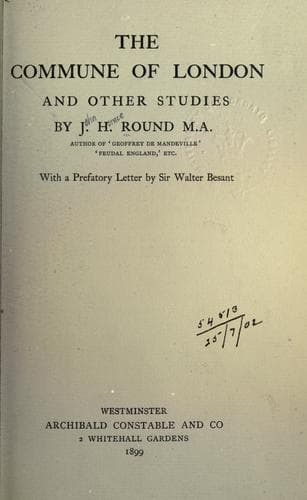
The Commune of London, and other studiesRound, John Horace
History
The Commune of London, and other studies
Round, John Horace
Great Britain -- History -- Norman period, 1066-1154; London (England) -- History -- To 1500
“unusquisque de i ... “only for one virgate
virgata. Et ita habetis ij each. _From them you can make
milites et dimidium feodatos.” up a knight_, and so you have
two and a half knights
enfeoffed” (p. 362).
The words I have italicised are, it will be seen, interpolated.
[134] See also Eyton’s ‘History of Shropshire,’ i. 232, and the ‘Cartæ
baronum’ (1166) _passim_.
[135] This allusion has perhaps been somewhat overlooked by legal
historians.
[136] Curiosities and Antiquities of the Exchequer.
[137] “Videtur autem eis obviare qui dicunt album firmæ a temporibus
Anglicorum cœpisse, quod in libro judiciario in quo totius regni
descriptio diligens continetur, et tam de tempore regis Edwardi quam de
tempore regis Willelmi sub quo factus est, singulorum fundorum valentia
exprimitur, nulla prorsus de albo firmæ fit mentio” (‘Dialogus,’ I.
vi.).
[138] Rot. magni Scacc. Norm., I. xv.
[139] The Foundations of England, i. 524; ii. 324.
[140] “Ubi cum per aliquos annos persedisset, comperit hoc solutionis
genere non plene fisco satisfieri: licet enim in numero et pondere
videretur satisfactum, non tamen in materia ... Ut igitur regiæ
simul et publicæ provideretur utilitati, habito super hoc ipso regis
consilio, constitutum est ut fieret ordine prædicto firmæ combustio vel
examinatio” (‘Dialogus,’ I. vii.).
[141] “Libræ arsæ et pensatæ,” “Libræ ad arsuram et pensum,” “Libræ ad
pensum et arsuram,” “Libræ ad pondus et arsuram,” “Libræ ad ignem et ad
pensum,” etc.
[142] Even Sir James Ramsay, though rightly sceptical as to the
attribution of certain innovations, by the writer of the ‘Dialogus,’ to
Bishop Roger, holds that “the revenues of the Anglo-Saxon kings were to
a considerable extent paid in kind; and so they were down to the time
of Henry I., who abolished the practice, establishing money payments in
all cases” (i. 525).
[143] Cf. p. 205.
[144] “Hiis vero solutis secundum constitutum modum cujusque rei,
regii officiales computabant vicecomiti _redigentes in summam
denariorum_: pro mensura scilicet tritici ad panem c hominum,
solidum unum,” etc., etc.
[145] Compare my remarks on the quick growth, in those days of
erroneous tradition, in ‘Studies on the Red Book of the Exchequer,’ p.
77.
[146] pp. 109–115. Professor Maitland has subsequently spoken of it in
two or three passages of ‘Domesday Book and Beyond.’
[147] “The Conqueror at Exeter” (‘Feudal England’).
[148] D. B., i. 108.
[149] D. B., i. 108.
[150] Barnstaple rendered forty shillings ‘ad pensum’ to the king,
and twenty ‘ad numerum’ to the bishop of Coutances; Lidford sixty ‘ad
pensum’; Totnes “olim reddebat iii lib. ad pensum et arsuram,” but,
after passing into private hands, its render was raised to “viii lib.
ad numerum.” Exeter itself ‘rendered’ £6 “ad pensum et arsuram” to the
king, and £12 ‘ad numerum’ for Queen Edith.
[151] D. B., i. 100 _b_-101.
Public-domain text, read in full here on John Shaqi.
Reviews
Reviews
No reviews yet
Be the first to share your thoughts on this work.
Elsewhere in the archive
Join the Discussion
Join the discussion
Sign in to leave a comment or review.
Sign InorCreate an account