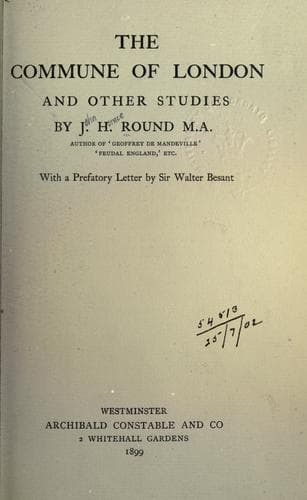
The Commune of London, and other studiesRound, John Horace
History
The Commune of London, and other studies
Round, John Horace
Great Britain -- History -- Norman period, 1066-1154; London (England) -- History -- To 1500
[100] Mr. Oman, for instance, writes of the English “ditch and the
mound made of the earth cast up from it and crowned by the breastworks”
(p. 154), although Mr. Freeman treated “the English fosse” as quite
distinct from “the palisades, and at a distance from them” (‘English
Historical Review,’ ix. 213). Mr. Archer has had to admit this.
[101] This is also the conclusion of Sir J. Ramsay.
[102] Feudal England, p. 361.
[103] Feudal England, pp. 354–358, 363, 367–8.
[104] Ibid. p. 358.
[105] Ibid. pp. 356–358.
[106] For further details on this subject, and a bibliography of the
whole controversy, see ‘Sussex Archæological Collections,’ vol. xlii.
[107] “Lincoln Castle, as regards its earthworks, belongs to that
type of English fortress in which the mound has its proper ditch,
and is placed on one side of an appended area, also with its bank
and ditch.... In general, these fortresses are much alike, and all
belong to that class of burhs known to have been thrown up by the
English in the ninth and tenth centuries” (Clark’s ‘Mediæval Military
Architecture,’ ii. 192).
[108] 9th July, 1898.
[109] Mediæval Military Architecture, i. 24, 25.
[110] Athenæum, July, 1898.
[111] History of the Art of War, p. 525. The italics are mine.
[112] Athenæum, 30th July, 1898.
[113] Ibid., 6th August, 1898.
[114] Ibid., 13th August, 1898.
[115] The acting editor of the ‘Athenæum’ refused to insert my final
reply explaining this.
[116] Appendix to ‘Ypodigma Neustriæ,’ p. 518.
[117] Flores Historiarum (Rolls), ii. 490.
[118] Ibid. p. 491.
[119] “Ipsi, obsidione turris fortissimæ, quam bellicis insultibus
et machinarum ictibus viisque subterraneis expugnatam, fuissent in
proximo adepturi, protinus dimissa, Londonias repetierunt” (‘Flores
Historiarum,’ ii. 491). Compare ‘Ypodigma Neustriæ,’ p. 518.
[120] Archæological Journal, xx. 205–223 (1863).
[121] First in the ‘English Historical Review’ and then in my ‘Feudal
England.’
[122] This was clearly the rule, though there may have been a few
exceptions. Compare p. 155 below.
[123] Feudal England, p. 234.
[124] History of the Art of War, p. 359.
[125] Ibid.
[126] Domesday Book and Beyond, pp. 450, 451.
[127] History of the Art of War.
[128] Feudal England, p. 234.
[129] History of the Art of War, p. 360.
[130] History of the Art of War, p. 362.
[131] I use the term, for convenience, in 1168.
[132] “_Habeo_ ij milites et dimidium feffatos de veteri
feffamento” (‘Liber Rubeus,’ p. 292).
[133] I may add that Mr. Oman misquotes this _carta_ in his
endeavour to extract from it support for his error about the ‘five
hides’ (p. 57 above). I place his rendering by the side of the text.
Public-domain text, read in full here on John Shaqi.
Reviews
Reviews
No reviews yet
Be the first to share your thoughts on this work.
Elsewhere in the archive
Join the Discussion
Join the discussion
Sign in to leave a comment or review.
Sign InorCreate an account