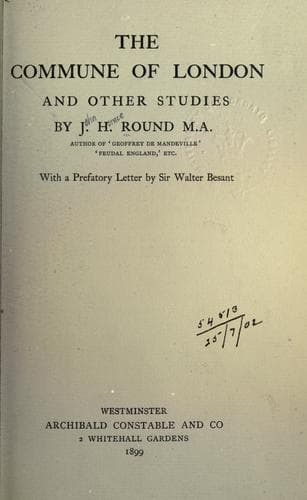
The Commune of London, and other studiesRound, John Horace
History
The Commune of London, and other studies
Round, John Horace
Great Britain -- History -- Norman period, 1066-1154; London (England) -- History -- To 1500
[186] “Margeria de Ripariis tenet villam de Creklade de camar[aria]
domini regis ad scaccarium: Eadem Margeria tenet villam de
Sevenha[m]pton cum pertinentiis de domino rege per predictum servitium”
(‘Testa de Nevill.,’ p. 153).
[187] See ‘Red Book of the Exchequer,’ and ‘Testa de Nevill.’
[188] Red Book of the Exchequer, p. cccxv.
[189] For a similar misdescription of the document preceding it see my
‘Studies on the Red Book of the Exchequer,’ p. 61.
[190] History of the Exchequer.
[191] Antiquities of the Exchequer, pp. 144–6, 165, 167.
[192] At Portsmouth, the witnesses being Geoffrey the chancellor, Nigel
de Albini, and Geoffrey de Clinton.
[193] Oliver’s ‘Monasticon Diocesis Exoniensis,’ p. 134.
[194] Ed. Arnold, i. 269.
[195] “Numero satisfaciunt; quales sunt Salop, Sudsex, Northumberland
et Cumberland” (i. 7). Shropshire is wanting on the Roll.
[196] “Hæc per subtractionem xii denariorum e singulis libris
dealbantur” (ii. 27).
[197] Rot. Pip., 31 Hen. I. p. 122.
[198] Indeed, the statement that this ferm was fixed by the Conqueror
is at variance with the evidence of Domesday, which says, “reddit
L libras ad arsuram et pensum” (i. 16).
[199] Vol. ii. p. 115.
[200] It should be observed that the plea was decided by reference to
the “liber de thesauro” (Domesday Book, 156 _b_) and that “liber
ille ... sigilli regii comes est in thesauro” (‘Dialogus,’ i. 15).
Therefore, “cum orta fuerit in regno contentio de his rebus quæ illic
annotantur” (Ibid. i. 16), the plea would conveniently be held “in
thesauro.”
[201] See my paper on “Bernard the Scribe” in the ‘English Historical
Review,’ 1899.
[202] Introduction to Dialogus.
[203] Ibid.
[204] “Id quoque sui esse juris suique specialiter privilegii ut si rex
ipsorum quoquo modo obiret, alius suo provisu in regno substituendus e
vestigio succederet” (‘Gesta Stephani’; see ‘Geoffrey de Mandeville,’
p. 2).
[205] Ibid.
[206] Longmans, 1892.
[207] Assuming the regnal years of Stephen to be reckoned in the usual
manner, of which I have felt some doubts.
[208] ‘Geoffrey de Mandeville,’ p. 252.
[209] Ibid. p. 373.
[210] He was the third named of the fifteen benefactors, who, to obtain
the king’s confirmation, “miserunt ... quendam ex seipsis, Ordgarum
scilicet le Prude,” to Henry. He occurs in one of the St. Paul’s
documents (Hist. MSS. Report, p. 68 _a_), but what Mr. Loftie has
written about him (‘London,’ pp. 35–6) is merely based on confusion
with other Ordgars.
[211] Vol. iv. fo. 737, of the Guildhall Transcript.
[212] He appears to take his stand on possession alone.
[213] The king decides to examine the title by a proprietary action.
[214] ‘Christo’ in Ancient Deeds, A. 6683.
Public-domain text, read in full here on John Shaqi.
Reviews
Reviews
No reviews yet
Be the first to share your thoughts on this work.
Elsewhere in the archive
Join the Discussion
Join the discussion
Sign in to leave a comment or review.
Sign InorCreate an account