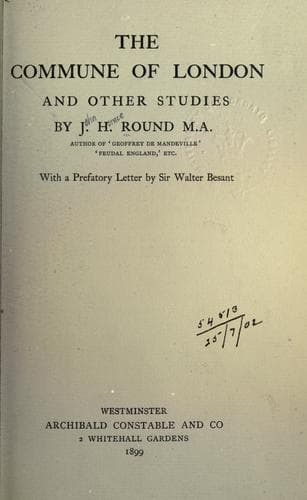
The Commune of London, and other studiesRound, John Horace
History
The Commune of London, and other studies
Round, John Horace
Great Britain -- History -- Norman period, 1066-1154; London (England) -- History -- To 1500
[215] As is not unfrequently the case in similar narratives, this
charter is wrongly introduced; for it clearly cannot be so early
as 1137. It was edited by me in ‘Ancient Charters’ (p. 48) from
Ancient Deeds, A. 6683, and assigned to 1143–1148, as being obviously
subsequent to the fall of the earl of Essex.
[216] See ‘Geoffrey de Mandeville,’ pp. 222–4.
[217] Trans: ‘Englis_t_c_u_it’ (the ‘t’ and ‘u’ being obvious
misreadings). The text is, it will be seen, corrupt.
[218] Trans: ‘Crichcote.’
[219] Report _ut supra_, p. 66 _b_; ‘Geoffrey de Mandeville,’
pp. 435–6.
[220] Report _ut supra_, pp. 61 _b_, 67 _b_; cf. ‘Domesday of St.
Paul’s,’ p. 124.
[221] London and Middlesex Archæological Transactions, vol. v., pp.
477–493. These documents are the same as those entered in the Priory’s
cartulary.
[222] Ibid. p. 480; cf. pp. 490, 491.
[223] London, p. 30.
[224] “Seven or eight” on p. 30.
[225] Ibid. p. 31.
[226] Even Dr. Stubbs seems to imply this when he alludes to “the
conversion of the cnihtengild into a religious house” (‘Const. Hist.’
[1874], i. 406).
[227] Compare “the retirement at one time of _seven_ or _eight_
aldermen” only three pages before (p. 30).
[228] p. 33. So also pp. 34, 42, 90.
[229] Coote, _ut supra_, p. 478.
[230] Good instances in point are found in the Ramsey cartulary, where,
in 1081, a benefactor to the abbey “suscepit e contra a domno abbate
et ab omnibus fratribus plenam fraternitatem pro rege Willelmo, et
pro regina Matilda, et pro comite Roberto, et pro semetipso, et uxore
sua, et filio qui ejus erit heres, et pro patre et matre ejus, ut sunt
participes orationum, elemosinarum, et omnium beneficiorum ipsorum, sed
et omnium fratrum sive monasteriorum a quibus societatem susceperunt
in omnibus sicut ex ipsis” (i. 127–8). Better still is this parallel:
“Reynaldus abbas, et totus fratrum conventus de Rameseya cunctis
fratribus qui sunt apud Ferefeld in gilda, salutem in Christo. Volumus
ut sciatis quod vobis nostrum fraternitatem concessimus et communionem
beneficii quam pro nobismet ipsis quotidie agimus, per Serlonem, qui
vester fuit legatus ad nos, ut sitis participes in hoc et in futuro
sæculo” (i. 131). The date of this transaction was about the same as
that of the admission of the cnihtengild to a share in the “benefits”
of Holy Trinity; and the grant was similarly made in return for an
endowment.
[231] See “The First Mayor of London” (‘Antiquary,’ April, 1887).
[232] Coote, _ut supra_, p. 478.
[233] Report, _ut supra_, p. 68 _a_.
[234] Ibid. p. 62 _a_.
[235] 5th Report Hist. MSS., App. I., p. 446 _b_.
[236] Rot. Pip., 31 Hen. I.
[237] _Infra_, p. 118.
[238] Antiquary, as above.
[239] Rot. Pip., 31 Hen. I.
[240] Report, i. 83 _b_. It is several years later than 1125.
[241] See p. 101, above.
[242] Coote, _ut supra_, p. 473.
[243] Tomlin’s ‘Perambulation of Islington,’ pp. 60–64.
[244] Report, _ut supra_, p. 42 _a_.
[245] See, for him, below.
[246] Add MS. 14,252, fo. 127 _d_.
Public-domain text, read in full here on John Shaqi.
Reviews
Reviews
No reviews yet
Be the first to share your thoughts on this work.
Elsewhere in the archive
Join the Discussion
Join the discussion
Sign in to leave a comment or review.
Sign InorCreate an account