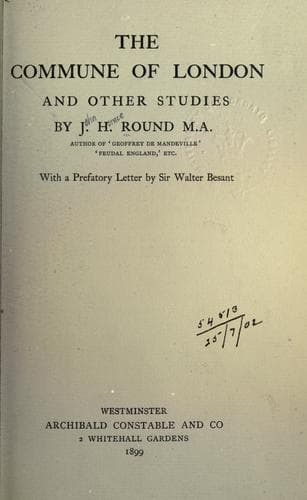
The Commune of London, and other studiesRound, John Horace
History
The Commune of London, and other studies
Round, John Horace
Great Britain -- History -- Norman period, 1066-1154; London (England) -- History -- To 1500
[277] Lansd. MS., 170, fo. 62 _d_. The terms of this writ are
of some legal importance in connection with the principle of “novel
disseisin” under Henry II. The recovery of seisin is here a preliminary
to a proprietary action, and the formula “injuste et sine judicio” (cf.
‘History of English Law,’ ii. 47, 57) recurs in this charter which is
of similar illustrative value: “Stephanus rex Angl[orum] Waltero filio
Gisleberti et preposito suo de Mealdona salutem. Si Canonici Sancti
Martini London’ poterint monstrare quod Oswardus de Meldon’ injuste et
sine judicio illos dissaisierit de terra sua de Meldon’ de Burgag’ tunc
precipio quod illos faciat[is] resaisiri sicut saisiti fuerunt die quo
Rex Henricus fuit vivus et mortuus. Et quicquid inde cepit postea reddi
juste faciatis et in pace teneant sicut tenuerunt tempore regis Henrici
et eadem consuetudine, et nisi feceritis Ricardus de Lucy et vicecomes
de Essex faciant fieri ne audiam inde clamorem pro penuria recti. Teste
Warnerio de Lusoriis apud London’” (Ib., fo. 170).
[278] It was almost certainly previous to Stephen’s captivity, though
this cannot be actually proved.
[279] Another writ of Stephen (date uncertain) similarly recognises
his position:--“Stephanus dei gratia Rex Anglie Osberto Octod[enarii]
et Adel (_sic_) et civibus et vic[ecomiti] Lond[onie] salutem.
Precipio quod canonici Sancti Martini London[ie] bene et in pace et
honorifice teneant terras suas et estalla sua que eis reddidi et
confirmavi” (fo. 57 _d_).
[280] Endorsed “de Cancellario” (9th Report Hist. MSS., i. 45 _b_).
[281] Athenæum, 23rd January, 1897.
[282] “Justitiarium qualem voluerint de se ipsis.”
[283] See ‘Geoffrey de Mandeville,’ p. 305.
[284] Ibid. p. 150.
[285] Quum.
[286] We probably should read “Osberto clerico Willelmi archidiaconi.”
[287] Attests a charter of the earl’s son and namesake in 1157–8 as
“Willelmo de Moch’ capellano meo” (‘Geoffrey de Mandeville,’ p. 229).
[288] Attests same charter (Ibid.).
[289]? Gisleberto.
[290] Ailwin son of Leofstan and Robert de Ponte occur in the London
charters of St. Paul’s about this time.
[291] Subsequently sheriff of Essex (see p. 109 above).
[292] This charter, I understand, is taken from the roll at St. Paul’s,
which was purposely left uncalendared in Sir H. Maxwell Lyte’s report
on the St. Paul’s MSS.
[293] See p. 102.
[294] Add. Cart. 28, 346.
[295] See my paper on “Faramus of Boulogne” (Genealogist [N. S.] xii.
151).
[296] Simone de Suttuna, Wulfwardo de Autona (Carshalton), etc.
[297] See ‘Geoffrey de Mandeville.’
[298] Rot. Pip. 31 Hen. I. p. 146.
[299] Ibid. p. 147.
[300] ‘Geoffrey de Mandeville.’
[301] Rot. Pip. 31 Hen. I. p. 146.
[302] Ibid.
[303] See above, p. 110.
[304] Add. Cart. 28, 344.
[305] Not to be confused with an (under) sheriff of Salop a generation
earlier.
[306] Cartulary of St. John’s, Colchester (Roxburghe Club), p. 78.
[307] Ramsey Cartulary, i. 139, where it is assigned to 1114–1123.
[308] Ibid. i. 144.
Public-domain text, read in full here on John Shaqi.
Reviews
Reviews
No reviews yet
Be the first to share your thoughts on this work.
Elsewhere in the archive
Join the Discussion
Join the discussion
Sign in to leave a comment or review.
Sign InorCreate an account