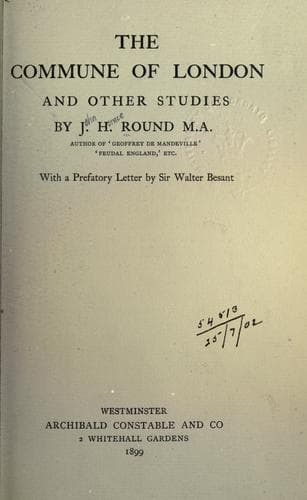
The Commune of London, and other studiesRound, John Horace
History
The Commune of London, and other studies
Round, John Horace
Great Britain -- History -- Norman period, 1066-1154; London (England) -- History -- To 1500
[309] Ibid. i. 152.
[310] Ibid. i. 148, 240.
[311] Ibid. i. 245.
[312] Ibid. i. 131.
[313] MS. Arundel, 28.
[314] Rot. Pip. 31 Hen. I. p. 100.
[315] Rot. Pip. 31 Hen. I. p. 72.
[316] Report, p. 25 _b_.
[317] Ramsey Cartulary, i. 256.
[318] See p. 101 above.
[319] 28th Sept., 1889.
[320] The Red Book of the Exchequer, Ed. Hubert Hall, F.S.A.,
of the Public Record Office (Master of the Rolls Series), pp.
cclxvii.-cclxxxiv.
[321] This phrase and the “sine judicio,” which the Articles employ as
its opposite, should be compared with the formula for the Assize of
Novel Disseisin.
[322] Rot. Pip. 14 Hen. II. p. 124 (“Honor Willelmi filii Alani”).
[323] See ‘Liber Rubeus,’ p. 272.
[324] Swereford’s ‘dictum’ is wrong, of course, here as elsewhere (see
my ‘Studies on the Red Book’).
[325] See, for example, pp. 75–7, 77–8.
[326] Or rather 1172 (Rot. Pip., 18 Hen. II.), “1171” being Mr. Hall’s
date.
[327] Roland de Dinan, Ralf de Toeni, Goscelin the queen’s brother
(Rot. 18 Hen. II., p. 132).
[328] Rot. 14 Hen. II., p. 194.
[329] Rot. 6 Ric. I. (according to Dugdale).
[330] Liber Rubeus, pp. 113, 147.
[331] Rot. 21 Hen. II., p. 82.
[332] History of Shropshire, ii. 201.
[333] Feudal England, p. 245; Geoffrey de Mandeville, p. 322.
[334] Rot. 14 Hen. II., p. 29.
[335] _i.e._ 1172.
[336] Rot. 18 Hen. II., p. 30.
[337] Genealogist (N. S.), vol. i.
[338] See my ‘Studies on the Red Book of the Exchequer’ (1898), printed
for private circulation, _passim_.
[339] This paper, written a few years ago, is a sketch based on (1) The
Song of Dermot and the Earl. Edited by G. A. Orpen. Oxford, 1892. (2)
Giraldi Cambrensis Opera, vol. v. Edited by J. F. Dimock. London, 1867.
(3) The Book of Howth. Edited by J. S. Brewer, 1871.
[340] English Historical Review, vol. iv.
[341] See the paper below on ‘The Marshalship of England.’
[342] English Historical Review, viii. 132.
[343] See my ‘Early Life of Anne Boleyn.’
[344] Romania, xxi. 444–451.
[345] See ‘Feudal England,’ pp. 516–518.
[346] Morant’s Essex, i. 331 note. Morant gives no reference for this
early and interesting charter, but I have lately been fortunate enough
to find it in Lansd. MS. fo. 170, where it is transcribed among some
local records from “Placita corone, 13 Edw. I.” It must, therefore,
have been produced in 1284–5.
[347] Son of the earl of Arundel.
[348] MS. Hargrave 313, fo. 44 _d_ (pencil).
[349] Selden Society publications, iv. 17.
[350] See also ‘Feudal England.’ Mr. Oman, of course, questions my
theory; but scholars, I understand, accept it (see pp. 56–7 above).
[351] See also my paper on “The Barons of the Naas” in ‘Genealogist.’
[352] 14th March, 1895.
Public-domain text, read in full here on John Shaqi.
Reviews
Reviews
No reviews yet
Be the first to share your thoughts on this work.
Elsewhere in the archive
Join the Discussion
Join the discussion
Sign in to leave a comment or review.
Sign InorCreate an account