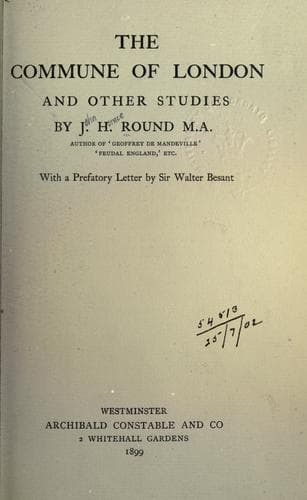
The Commune of London, and other studiesRound, John Horace
History
The Commune of London, and other studies
Round, John Horace
Great Britain -- History -- Norman period, 1066-1154; London (England) -- History -- To 1500
[586] Ibid. p. 203. It will be observed that this description of
the Scots--“quasi sepes densa”--is an admirable parallel to the
metaphor--“quasi castellum”--which Henry of Huntingdon applies to the
English “acies” at the Battle of Hastings, and which Mr. Freeman so
deplorably misunderstood (‘Feudal England,’ p. 343–4). So, too, Adam de
Murimuth speaks of the French fleet at the Battle of Sluys (1340) as
“quasi castrorum acies (or aciem) ordinatum” (p. 106). Such metaphors,
I have shown, were common.
[587] Vol. vii. p. 122.
[588] Vol. iii. p. xxi.
[589] History of England, p. 174.
[590] Mr. Oman reckons the men of the “Marcher Lords” at 1,850. I make
them 2,040.
[591] Ed. Record Commission.
[592] Except a special body of 100 men from the Forest of Dean whence
the necessary miners were always obtained.
[593] History of the Art of War, pp. 593–4.
[594] “Commissioners of Array for all counties citra Trent”
(Wrottesley’s ‘Creçy and Calais,’ p. 8; cf. Ibid. pp. 58–61).
[595] Ibid. pp. 67–8.
[596] Rotuli Scotiæ, i. p. 127.
[597] Since this was written Mr. Morris has independently observed that
40,000 or even 10,000 horse are impossible (‘Eng. Hist. Rev.,’ xiv.
133).
[598] I omit, as he does, in this reckoning, any contingents from
elsewhere.
[599] The italics are mine.
[600] The italics are mine.
[601] “The host was told off into ten battles, probably (like the
French at Creçy) in three lines of three battles each, with the tenth
as a reserve under the king” (p. 574). But in the earlier plans the
English battles are shown in _single_ line, and in the earliest,
at least, with a widely extended front.
[602] The italics are mine.
[603] The italics are mine.
[604] Art of War in Middle Ages, 104; Social England,, ii. 174–176;
History of England, pp. 187–8; History of the Art of War, pp. 604–615.
[605] Mélanges Julien Havet: La date de la composition du ‘Modus
tenendi Parliamentum in Anglia’ (1895).
[606] M. Bémont, by a slip, describes him (p. 471), as “exerçant la
charge de grand connétable (_sic_) d’Angleterre au couronnement de
Richard II.”
[607] See Mr. Watson’s Note in ‘Complete Peerage,’ vi. p. 197.
[608] Ibid. v. p. 260; also Doyle’s ‘Official Baronage.’
[609] M. Bémont writes that he “vivait au temps de Richard II., non de
Henri II.” But this is a misconception.
[610] Hearne’s ‘Curious Discourses,’ ii. 90–97.
[611] Ibid. pp. 327–330.
[612] Rot. Chart., i. 46.
[613] M. Paris, ‘Chronica Majora.’
[614] Calendar of Patent Rolls, 1307–1313, p. 6.
[615] Ibid. p. 51.
[616] Const. Hist., ii. 328.
[617] He was one of those besieging him in Scarborough Castle, May,
1312.
[618] Ed. Hearne, p. 103.
[619] Dictionary of National Biography, li. 204.
Public-domain text, read in full here on John Shaqi.
Reviews
Reviews
No reviews yet
Be the first to share your thoughts on this work.
Elsewhere in the archive
Join the Discussion
Join the discussion
Sign in to leave a comment or review.
Sign InorCreate an account