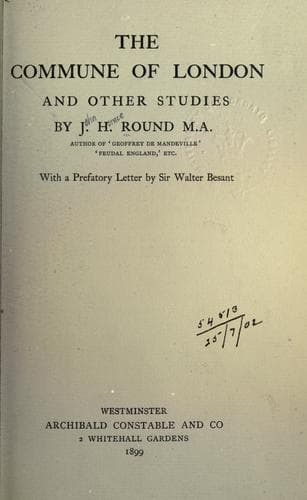
The Commune of London, and other studiesRound, John Horace
History
The Commune of London, and other studies
Round, John Horace
Great Britain -- History -- Norman period, 1066-1154; London (England) -- History -- To 1500
[620] The matter has been further complicated by the index to the
official calendar of Edward II. Close Rolls, which gives a “Walter de
Ferrariis, marshal of England.” The document indexed proves (p. 189)
to be a reference (6th July, 1315) to Walter (earl of Pembroke), “late
marshal of England.”
[621] Trivet, it is true, even earlier (_circ._ 1300), wrote
of Strongbow as ‘Marshal of England’:--“Ricardus Comes de Strogoil,
marescallus Angliæ, terris suis omnibus propter quondam offensam in
manu regis acceptis, exsul in Hibernia moratur. Hunc Ricardum Anglici
ob præcipuum fortitudinem ‘Strangebowe’ cognominabant” (p. 66). But
although the writer may sometimes preserve a forgotten story, he cannot
be accepted as an authority for earl Richard’s tenure of an office, of
which there is absolutely no trace in any contemporary chronicle or
record.
[622] Dictionary of National Biography.
[623] Complete Peerage, vi. 197, 198.
[624] Now MS. Ar. xix. (Brit. Mus.).
[625] The italics and commas are mine, and show how the alleged son of
earl Richard was fabricated.
[626] Mr. Watson (‘Complete Peerage,’ vi. 197) states that Giraldus
Cambrensis speaks of “Richard Strongbow, earl of Strigul,” but this is
a misapprehension.
[627] Dictionary of Nat. Biography, p. 393.
[628] It was inspected by Edw. I. at Carlisle, 20th March, 1307. Its
mention (‘Mon. Ang.’ v. 268) of “Gilberti et Ricardi Strongbowe”
clearly proves that it applied the name to both.
[629] Hearne’s ‘Discourses,’ ii. 132–4; ‘Calendar of Close Rolls,’
p. 558. The reply is of interest as showing that they identified the
marshalship of England with that in the “Constitutio.”
[630] Hearne’s ‘Discourses,’ ii. 135–7. This petition, in
Norman-French, is of interest for certain additions and for the loose
use of “countes mareschauls” as the title of his predecessors from the
first.
[631] Ibid. pp. 143–5.
[632] Altered in MS.
[633] 133 in the pencil numbering.
[634] In special classes on Palæography and Diplomatic at the London
School of Economics.
[635] See ‘Studies on the Red Book of the Exchequer,’ p. 34, where the
reference is to Mr. Hall’s citing the “pr_æ_missa scutagia” of his
MS. as “pr_o_missa scutagia” (pp. clxxii., clxxvii., etc.), and
arguing therefrom. See also Ibid. p. 29.
[636] “There is a treatise carryed about the office of the earle
marshall in the tyme of King Henry the Second, and another of the tyme
of Thomas of Brotherton” (Hearne’s ‘Discourses,’ II. 95).
[637] The Society of Antiquaries possesses an early English version
of the ‘Modus’ to which is prefixed a table of chapters both for the
‘Modus’ and for the treatise on the Marshal’s office.
[638] He was earl of Norfolk.
[639] Vol v. pp. 260, 261.
Public-domain text, read in full here on John Shaqi.
Reviews
Reviews
No reviews yet
Be the first to share your thoughts on this work.
Elsewhere in the archive
Join the Discussion
Join the discussion
Sign in to leave a comment or review.
Sign InorCreate an account