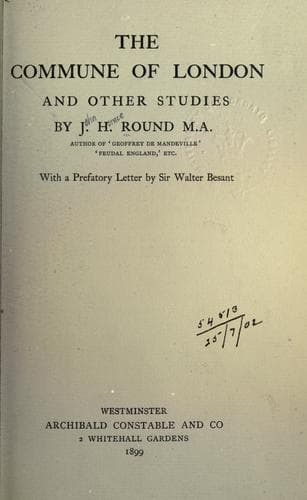
The Commune of London, and other studiesRound, John Horace
History
The Commune of London, and other studies
Round, John Horace
Great Britain -- History -- Norman period, 1066-1154; London (England) -- History -- To 1500
[640] “Sciatis quod, cum carissimum fratrem nostrum Thomam de Holand,
comitem Kancie de _officio marescalli Angl[ie]_, quod nuper
habuit ex concessione nostra, exoneraverimus, Nos ea de causa dilectum
consanguineum et fidelem nostrum Thomam Comitem Notyngh’ ad _dictum
officium_ ordinavimus, habendum cum feodis et omnibus aliis ad
officium illud spectantibus ad totam vitam ipsius,” etc. (Pat. 9 Ric.
II., part 1, m. 38).
[641] Dictionary of National Biography.
[642] Dictionary of National Biography.
[643] The witnesses were the archbishop of Canterbury, the bishops of
London and Winchester, John of Gaunt, the dukes of York and Gloucester,
the earls of Arundel, Stafford, and Suffolk, Hugh de Segrave the
treasurer and John de Montacute steward of the household.
[644] p. 311 above.
[645] It seems to have become in the Parliamentary confirmation of 1397
“Earl Marshal of England.”
[646] Mr. Kingsford, in the ‘Dictionary of National Biography’ (xxxvi.
232), complicates the matter further by writing of Walter earl of
Pembroke: “The office of Marshal passed through his eldest daughter to
the Bigods, earls of Norfolk, and through them to the Mowbrays, and
eventually to the Howards,” etc. The Mowbrays, of course, obtained it
under a new creation, and in no way through the Bigods.
[647] Derby was the Steward’s son and heir.
[648] Dr. Stubbs observes that “from the king’s later action, it
is clear that both parties had in view the measures taken for the
deposition of Edward II.” But there is more direct evidence. On the
Rolls of Parliament (III. 376) it is one of the charges against the
Lords Appellant that they “firent chercher Recordes deins votre
Tresoree de temps le roi Edward vostre besaiel coment vostre dit
besaiel demist de sa Couronne, Et monstrerent en escript a Vous,” etc.,
etc.
[649] M. Bémont, who approached the question from the standpoint of
the MSS., claimed that only one (Vesp. B. vii.) of them could possibly
be as old as the days of Edward II., and that even this must be proved
“par des raisons paléographiques.” The officials of the MS. department,
Brit. Mus., kindly examined it for me, and pronounced it to be clearly
of the reign of Richard II., which confirms his conclusion. M. Bémont,
however, held that the MSS. “ont été composés et écrits dans les
premières années de Richard II., ou dérivent de manuscrits rédigés à
cette époque,” on account of the prominent place assigned in them to
Richard’s coronation. I should place the date a few years later.
[650] “The Present Status and Prospects of Historical Study” (‘Lectures
in Mediæval and Modern History,’ pp. 41–2).
[651] See my article on “Historical Research,” in ‘Nineteenth Century,’
December, 1898.
Transcriber’s Notes:
1. Obvious printers’, punctuation and spelling errors have been
corrected silently.
2. Some hyphenated and non-hyphenated versions of the same words have
been retained as in the original.
Public-domain text, read in full here on John Shaqi.
Reviews
Reviews
No reviews yet
Be the first to share your thoughts on this work.
Elsewhere in the archive
Join the Discussion
Join the discussion
Sign in to leave a comment or review.
Sign InorCreate an account