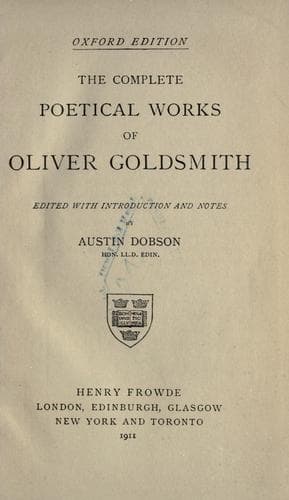
The Complete Poetical Works of Oliver GoldsmithGoldsmith, Oliver
General
The Complete Poetical Works of Oliver Goldsmith
Goldsmith, Oliver
English poetry; Literature -- Collections
She leaves at last, or feebly mans the soul.
This was changed in the second, third, fourth, and fifth editions to:—
When noble aims have suffer’d long controul,
They sink at last, or feebly man the soul.
No product here, etc. The Swiss mercenaries, here
referred to, were long famous in European warfare.
They parted with a thousand kisses,
And fight e’er since for pay, like Swisses.
Gay’s _Aye and No, a Fable_.
breasts This fine use of ‘breasts’—as
Cunningham points out—is given by Johnson as an example in his
Dictionary.
With patient angle, trolls the finny deep. ‘Troll,’
i.e. as for pike. Goldsmith uses ‘finny prey’ in _The Citizen of the
World_, 1762, ii. 99:—‘The best manner to draw up the _finny
prey_.’ Cf. also ‘warbling grove,’ _Deserted Village_, l.
361, as a parallel to ‘finny deep.’
the struggling savage, i.e. wolf or bear. Mitford
compares the following:—‘He is a beast of prey, and the laws should
make use of as many stratagems and as much force to drive the _
reluctant savage_ into the toils, as the Indians when they hunt the
hyena or the rhinoceros.’ (_Citizen of the World_, 1762, i.
112.) See also Pope’s _Iliad_, Bk. xvii:—
But if the _savage_ turns his glaring eye,
They howl aloof, and round the forest fly.
lines 201–2 are not in the first edition.
For every want, etc. Mitford quotes a parallel
passage in _Animated Nature_, 1774, ii. 123:—‘Every want
thus becomes a means of pleasure, in the redressing.’
Their morals, like their pleasures, are but low.
Probably Goldsmith only uses ‘low’ here in its primitive sense, and not in
that which, in his own day, gave so much umbrage to so many
eighteenth-century students of humanity in the rough. Cf. Fielding, _Tom
Jones_, 1749, iii. 6:— ‘Some of the Author’s Friends cry’d—“Look’e,
Gentlemen, the Man is a Villain; but it is Nature for all that.” And all
the young Critics of the Age, the Clerks, Apprentices, etc., called it _Low_
and fell a Groaning.’ See also _Tom Jones_, iv. 94, and 226–30.
‘There’s nothing comes out but the ‘most lowest’ stuff in nature’—says
Lady Blarney in ch. xi of the _ Vicar_, whose author is
eloquent on this topic in _The Present State of Polite Learning_,
1759, pp. 154–6, and in
_She Stoops to Conquer_, 1773 (Act i); while Graves (_Spiritual
Quixote_, 1772, bk. i, ch. vi) gives the fashion the scientific
appellation of _ tapino-phoby,_ which he defines as ‘a dread of
everything that is _low_, either in writing or in conversation.’ To
Goldsmith, if we may trust George Colman’s _Prologue_ to Miss
Lee’s _Chapter of Accidents_, 1780, belongs the credit of
exorcising this particular form of depreciation:—
Public-domain text, read in full here on John Shaqi.
Reviews
Reviews
No reviews yet
Be the first to share your thoughts on this work.
Elsewhere in the archive
Join the Discussion
Join the discussion
Sign in to leave a comment or review.
Sign InorCreate an account