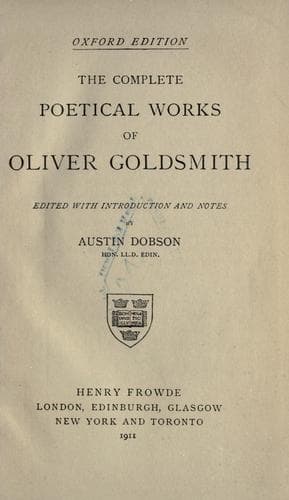
The Complete Poetical Works of Oliver GoldsmithGoldsmith, Oliver
General
The Complete Poetical Works of Oliver Goldsmith
Goldsmith, Oliver
English poetry; Literature -- Collections
Princes and lords are but the breath of kings.
But Prior finds the exact equivalent of the second line in the verses of
an old French poet, De. Caux, upon an hour-glass:—
C’est un verre qui luit,
Qu’un souffle peut détruire, et qu’un souffle a
produit.
A time there was, ere England’s griefs began. Here
wherever the locality of Auburn, the author had clearly England in mind. A
caustic commentator has observed that the ‘time’ indicated must have been
a long while ago.
opulence. In the first edition the word is
‘luxury.’
And, many a year elapsed, return to view. ‘It is
strongly contended at Lishoy, that “_the Poet_,” as he is usually
called there, after his pedestrian tour upon the Continent of Europe,
returned to and resided in the village some time. . . . It is moreover
believed, that the havock which had been made in his absence among those
favourite scenes of his youth, affected his mind so deeply, that he
actually composed great part of the Deserted Village ‘at’ Lishoy.’ (_Poetical
Works, with Remarks_, etc., by the Rev. R. H. Newell, 1811, p. 74.)
Notwithstanding the above, there is no evidence that Goldsmith ever
returned to his native island. In a letter to his brother-in-law, Daniel
Hodson, written in 1758, he spoke of hoping to do so ‘in five or six
years.’ (_Percy Memoir_, 1801, i. 49). But in another letter,
written towards the close of his life, it is still a thing to come. ‘I am
again,’ he says, ‘just setting out for Bath, and I honestly say I had much
rather it had been for Ireland with my nephew, but that pleasure I hope to
have before I die.’ (Letter to Daniel Hodson, no date, in possession of
the late Frederick Locker Lampson.)
Where once the cottage stood, the hawthorn grew.
Here followed, in the first edition:—
Here, as with doubtful, pensive steps I range,
Trace every scene, and wonder at the change,
Remembrance, etc.
In all my griefs—and God has given my share.
Prior notes a slight similarity here to a line of Collins:—
Ye mute companions of my toils, that bear,
_In all my griefs_, a more than equal share!
_Hassan; or, The Camel Driver._
In _The Present State of Polite Learning_, 1759, p. 143,
Goldsmith refers feelingly to ‘the neglected author of the Persian
eclogues, which, however inaccurate, excel any in our language.’ He
included four of them in _The Beauties of English Poesy_, 1767,
i. pp. 239–53.
To husband out, etc. In the first edition this ran:—
My anxious day to husband near the close,
And keep life’s flame from wasting by repose.
Public-domain text, read in full here on John Shaqi.
Reviews
Reviews
No reviews yet
Be the first to share your thoughts on this work.
Elsewhere in the archive
Join the Discussion
Join the discussion
Sign in to leave a comment or review.
Sign InorCreate an account