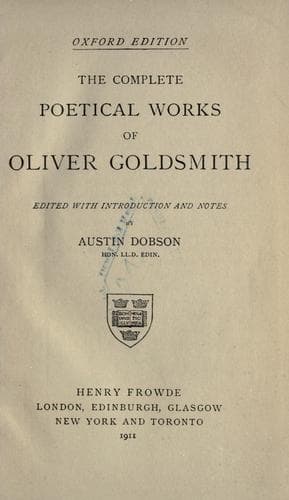
The Complete Poetical Works of Oliver GoldsmithGoldsmith, Oliver
General
The Complete Poetical Works of Oliver Goldsmith
Goldsmith, Oliver
English poetry; Literature -- Collections
Here to return—and die at home at last.
Forster compares a passage in _The Citizen of the World_, 1762,
ii. 153:—‘There is something so seducing in that spot in which we
first had existence, that nothing but it can please; whatever vicissitudes
we experience in life, however we toil, or wheresoever we wander, our
fatigued wishes still recur to home for tranquillity, we long to die in
that spot which gave us birth, and in that pleasing expectation opiate
every calamity.’ The poet Waller too—he adds—wished to die
‘like the stag where he was roused.’ (_Life_, 1871, ii. 202.)
[Illustration: ]
South View from Goldsmith’s Mount
(R.H. Newell)
How happy he. ‘How blest is he’ in the first
edition.
And, since ’tis hard to combat, learns to fly.
Mitford compares _The Bee_ for October 13, 1759, p. 56:—‘By
struggling with misfortunes, we are sure to receive some wounds in the
conflict. The only method to come off victorious, is by running away.’
surly porter. Mr. J. M. Lobban compares the _Citizen
of the World_, 1762, i. 123:—‘I never see a nobleman’s door
half opened that some surly porter or footman does not stand full in the
breach.’ (_Select Poems of Goldsmith_, 1900, p. 98.)
Bends. ‘Sinks’ in the first edition. _unperceived
decay_. Cf. Johnson, _Vanity of Human Wishes_, 1749, l. 292:—
An age that melts with unperceiv’d decay,
And glides in modest innocence away;
and _Irene_, Act ii, Sc. 7:—
And varied life steal unperceiv’d away.
While Resignation, etc. In 1771 Sir Joshua
exhibited a picture of ‘An Old Man,’ studied from the beggar who was his
model for Ugolino. When it was engraved by Thomas Watson in 1772, he
called it ‘Resignation,’ and inscribed the print to Goldsmith in the
following words:—‘This attempt to express a Character in _The
Deserted Village_, is dedicated to Dr. Goldsmith, by his sincere
Friend and admirer, JOSHUA REYNOLDS.’
Up yonder hill. It has been suggested that
Goldsmith was here thinking of the little hill of Knockaruadh (Red Hill)
in front of Lissoy parsonage, of which there is a sketch in Newell’s _Poetical
Works_, 1811. When Newell wrote, it was already known as
‘Goldsmith’s mount’; and the poet himself refers to it in a letter to his
brother-in-law Hodson, dated Dec. 27, 1757:—‘I had rather be placed
on the little mount before Lishoy gate, and there take in, to me, the most
pleasing horizon in nature.’ (_Percy Memoir_, 1801, p. 43.)
And fill’d each pause the nightingale had made. In
_Animated Nature_, 1774, v. 328, Goldsmith says:—‘The
nightingale’s pausing song would be the proper epithet for this bird’s
music.’ [Mitford.]
Public-domain text, read in full here on John Shaqi.
Reviews
Reviews
No reviews yet
Be the first to share your thoughts on this work.
Elsewhere in the archive
Join the Discussion
Join the discussion
Sign in to leave a comment or review.
Sign InorCreate an account