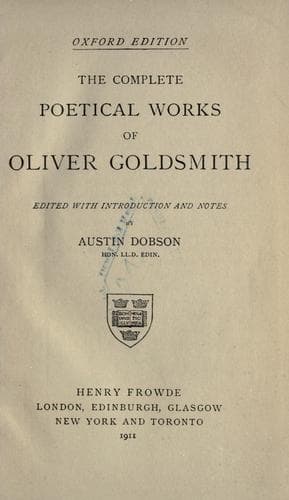
The Complete Poetical Works of Oliver GoldsmithGoldsmith, Oliver
General
The Complete Poetical Works of Oliver Goldsmith
Goldsmith, Oliver
English poetry; Literature -- Collections
Full well they laugh’d, etc. Steele, in _Spectator_,
No. 49 (for April 26, 1711) has a somewhat similar thought:—‘_Eubulus_
has so great an Authority in his little Diurnal Audience, that when he
shakes his Head at any Piece of publick News, they all of them appear
dejected; and, on the contrary, go home to their Dinners with a good
Stomach and chearful Aspect, when _Eubulus_ seems to intimate
that Things go well.’
Yet he was kind, etc. For the rhyme of ‘fault’ and
‘aught’ in this couplet Prior cites the precedent of Pope:—
Before his sacred name flies ev’ry fault,
And each exalted stanza teems with thought!
(_Essay on Criticism_, l. 422). He might also have cited
Waller, who elides the ‘l’:—
Were we but less indulgent to our fau’ts,
And patience had to cultivate our thoughts.
Goldsmith uses a like rhyme in _Edwin and Angelina_, Stanza
xxxv:—
But mine the sorrow, mine the fault,
And well my life shall pay;
I’ll seek the solitude he sought,
And stretch me where he lay.
Cf. also _Retaliation_, ll. 73–4. Perhaps—as indeed Prior
suggests—he pronounced ‘fault’ in this fashion.
[Illustration: ]
THE SCHOOL HOUSE
(R. H. Newell)
That one small head could carry all he knew. Some
of the traits of this portrait are said to be borrowed from Goldsmith’s
own master at Lissoy:—‘He was instructed in reading, writing, and
arithmetic’—says his sister Catherine, Mrs. Hodson—‘by a
schoolmaster in his father’s village, who had been a quartermaster in the
army in Queen Anne’s wars, in that detachment which was sent to Spain:
having travelled over a considerable part of Europe and being of a very
romantic turn, he used to entertain Oliver with his adventures; and the
impressions these made on his scholar were believed by the family to have
given him that wandering and unsettled turn which so much appeared in his
future life.’ (_Percy Memoir_, 1801, pp. 3–4.) The name of this
worthy, according to Strean, was Burn (Byrne). (Mangin’s _ Essay on
Light Reading_, 1808, p. 142.)
Near yonder thorn. See note to l. 13.
The chest contriv’d a double debt to pay. Cf. the
_Description of an Author’s Bedchamber_, p. 48, l. ult.:—
A cap by night—a stocking all the day!
Public-domain text, read in full here on John Shaqi.
Reviews
Reviews
No reviews yet
Be the first to share your thoughts on this work.
Elsewhere in the archive
Join the Discussion
Join the discussion
Sign in to leave a comment or review.
Sign InorCreate an account