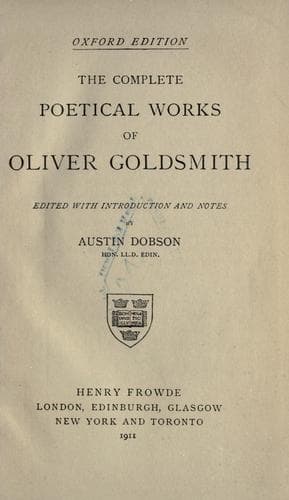
The Complete Poetical Works of Oliver GoldsmithGoldsmith, Oliver
General
The Complete Poetical Works of Oliver Goldsmith
Goldsmith, Oliver
English poetry; Literature -- Collections
The twelve good rules. ‘A constant one’ (i.e.
picture) ‘in every house was “King Charles’ Twelve Good Rules.”’ (Bewick’s
_Memoir_, ‘Memorial Edition,’ 1887, p. 262.) This old
broadside, surmounted by a rude woodcut of the King’s execution, is still
prized by collectors. The rules, as ‘found in the study of King Charles
the First, of Blessed Memory,’ are as follow:— ‘1. Urge no healths;
2. Profane no divine ordinances; 3. Touch no state matters; 4. Reveal no
secrets; 5. Pick no quarrels; 6. Make no comparisons; 7. Maintain no ill
opinions; 8. Keep no bad company; 9. Encourage no vice; 10. Make no long
meals; 11. Repeat no grievances; 12. Lay no Wagers.’ Prior, _Misc.
Works_, 1837, iv. 63, points out that Crabbe also
makes the ‘Twelve Good Rules’ conspicuous in the _Parish Register_
(ll. 51–2):—
There is King Charles, and all his Golden Rules,
Who proved Misfortune’s was the best of schools.
Her late Majesty, Queen Victoria, kept a copy of these rules in the
servants’ hall at Windsor Castle.
the royal game of goose. The ‘Royal and
Entertaining Game of the Goose’ is described at length in Strutt’s _Sports
and Pastimes_, bk. iv, ch. 2 (xxv). It may be briefly defined as a
game of compartments with different titles through which the player
progresses according to the numbers he throws with the dice. At every
fourth or fifth compartment is depicted a goose, and if the player’s cast
falls upon one of these, he moves forward double the number of his throw.
While broken tea-cups. Cf. the _Description of
an Author’s Bedchamber_, p. 48, l. 18:—
And five crack’d teacups dress’d the chimney board.
Mr. Hogan, who repaired or rebuilt the ale-house at Lissoy, did not
forget, besides restoring the ‘Royal Game of Goose’ and the ‘Twelve Good
Rules,’ to add the broken teacups, ‘which for better security in the frail
tenure of an Irish publican, or the doubtful decorum of his guests, were
embedded in the mortar.’ (Prior, _Life_, 1837, ii. 265.)
Shall kiss the cup. Cf. Scott’s _Lochinvar_:—
The bride kissed the goblet: the knight took it up,
He quaff’d off the wine and he threw down the cup.
Cf. also _The History of Miss Stanton_ (_British Magazine_,
July, 1760).—‘The earthen mug went round. _Miss touched the cup_,
the stranger pledged the parson,’ etc.
Between a splendid and a happy land. Prior compares
_The Citizen of the World_, 1762, i. 98:—‘Too much
commerce may injure a nation as well as too little; and . . . there is a
wide difference between a conquering and a flourishing empire.’
To see profusion that he must not share. Cf. _Animated
Nature_, iv. p. 43:—‘He only guards those luxuries he is not
fated to share.’ [Mitford.]
Public-domain text, read in full here on John Shaqi.
Reviews
Reviews
No reviews yet
Be the first to share your thoughts on this work.
Elsewhere in the archive
Join the Discussion
Join the discussion
Sign in to leave a comment or review.
Sign InorCreate an account