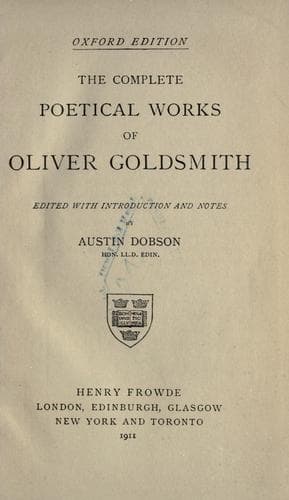
The Complete Poetical Works of Oliver GoldsmithGoldsmith, Oliver
General
The Complete Poetical Works of Oliver Goldsmith
Goldsmith, Oliver
English poetry; Literature -- Collections
From Letter cxiii of _The Citizen of the World_, 1762, ii. 209,
first printed in _The Public Ledger_, May 13, 1761.
THE DOUBLE TRANSFORMATION.
_The Double Transformation_ first appeared in _Essays: By
Mr. Goldsmith_, 1765, where it figures as Essay xxvi, occupying pp.
229–33. It was revised for the second edition of 1766, becoming Essay
xxviii, pp. 241–45. This is the text here followed. The poem is an obvious
imitation of what its author calls (_Letters from a Nobleman to his
Son_, 1764, ii. 140) that ‘French elegant easy manner of telling a
story,’ which Prior had caught from La Fontaine. But the inherent
simplicity of Goldsmith’s style is
curiously evidenced by the absence of those illustrations and ingenious
allusions which are Prior’s chief characteristic. And although Goldsmith
included _The Ladle_ and _Hans Carvel_ in his _Beauties
of English Poesy_, 1767, he refrained wisely from copying the
licence of his model.
Jack Book-worm led a college life. The version of
1765 reads ‘liv’d’ for ‘led’.
And freshmen wonder’d as he spoke. The earlier
version adds here—
Without politeness aim’d at breeding,
And laugh’d at pedantry and reading.
Her presence banish’d all his peace. Here in the
first version the paragraph closes, and a fresh one is commenced as
follows:—
Our alter’d Parson now began
To be a perfect ladies’ man;
Made sonnets, lisp’d his sermons o’er,
And told the tales he told before,
Of bailiffs pump’d, and proctors bit,
At college how he shew’d his wit;
And, as the fair one still approv’d,
He fell in love—or thought he lov’d.
So with decorum, etc.
The fifth line was probably a reminiscence of the college riot in which
Goldsmith was involved in May, 1747, and for his part in which he was
publicly admonished. (See _Introduction_,
p. xi, l. 3.)
usage. This word, perhaps by a printer’s error, is
‘visage’ in the first version.
Skill’d in no other arts was she. Cf. Prior:—
For in all Visits who but She,
To Argue, or to Repartee.
Five greasy nightcaps wrapp’d her head. Cf. _Spectator_,
No. 494— ‘At length the Head of the Colledge came out to him, from
an inner Room, with half a Dozen Night-Caps upon his Head.’ See also
Goldsmith’s essay on the Coronation (_Essays_, 1766, p. 238),
where Mr. Grogan speaks of his wife as habitually
‘mobbed up in flannel night caps, and trembling at a breath of air.’
By day, ’twas gadding or coquetting. The first
version after ‘coquetting’ begins a fresh paragraph with—
Now tawdry madam kept, etc.
A sigh in suffocating smoke. Here in the first
version follows:—
She, in her turn, became perplexing,
Public-domain text, read in full here on John Shaqi.
Reviews
Reviews
No reviews yet
Be the first to share your thoughts on this work.
Elsewhere in the archive
Join the Discussion
Join the discussion
Sign in to leave a comment or review.
Sign InorCreate an account