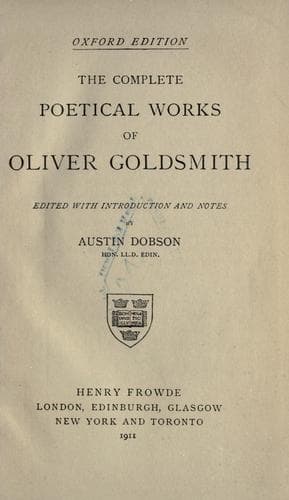
The Complete Poetical Works of Oliver GoldsmithGoldsmith, Oliver
General
The Complete Poetical Works of Oliver Goldsmith
Goldsmith, Oliver
English poetry; Literature -- Collections
And found substantial bliss in vexing.
Thus every hour was pass’d, etc.
Thus as her faults each day were known. First
version: ‘Each day, the more her faults,’ etc.
Now, to perplex. The first version has ‘Thus.’ But
the alteration in line 61 made a change necessary.
paste. First version ‘pastes.’
condemn’d to hack, i.e. to hackney, to plod.
A NEW SIMILE.
The _New Simile_ first appears in _Essays: By Mr.
Goldsmith_, 1765, pp. 234–6, where it forms Essay xxvii. In the
second edition of 1766 it occupies pp. 246–8 and forms Essay xix. The
text here followed is that of the second edition, which varies slightly
from the first. In both cases the poem is followed by the enigmatical
initials ‘*J. B.,’ which, however, as suggested by Gibbs, may simply stand
for ‘Jack Bookworm’ of _The Double Transformation_. (See p.
204.)
Long had I sought in vain to find. The text of 1765
reads—
‘I long had rack’d my brains to find.’
Tooke’s Pantheon. Andrew Tooke (1673–1732) was
first usher and then Master at the Charterhouse. In the latter capacity he
succeeded Thomas Walker, the master of Addison and Steele. His _
Pantheon_, a revised translation from the Latin of the Jesuit,
Francis Pomey, was a popular school-book of mythology, with copper-plates.
Wings upon either side—mark that. The petasus
of Mercury, like his sandals (l. 24), is winged.
No poppy-water half so good. Poppy-water, made by
boiling the heads of the white, black, or red poppy, was a favourite
eighteenth-century soporific:—‘Juno shall give her peacock
_poppy-water_, that he may fold his ogling tail.’ (Congreve’s
_Love for Love_, 1695, iv. 3.)
With this he drives men’s souls to hell.
Tu....
....virgaque levem coerces
Aurea turbam.—Hor. _Od_. i. 10.
Moreover, Merc’ry had a failing.
Te canam....
Callidum, quidquid placuit, iocoso
Condere furto.—Hor. _Od_. i. 10.
Goldsmith, it will be observed, rhymes ‘failing’ and ‘stealing.’ But Pope
does much the same:—
That Jelly’s rich, this Malmsey healing,
Pray dip your Whiskers and your tail in.
(_Imitation of Horace_, Bk. ii, Sat. vi.)
Unless this is to be explained by poetical licence, one of these words
must have been pronounced in the eighteenth century as it is not
pronounced now.
In which all modern bards agree. The text of 1765
reads ‘our scribling bards.’
EDWIN AND ANGELINA.
Public-domain text, read in full here on John Shaqi.
Reviews
Reviews
No reviews yet
Be the first to share your thoughts on this work.
Elsewhere in the archive
Join the Discussion
Join the discussion
Sign in to leave a comment or review.
Sign InorCreate an account