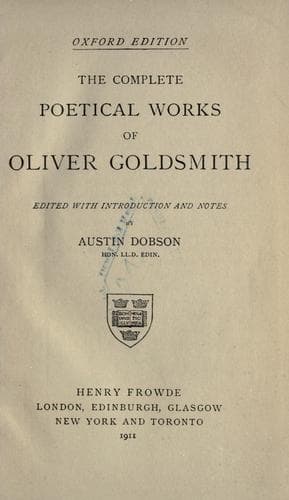
The Complete Poetical Works of Oliver GoldsmithGoldsmith, Oliver
General
The Complete Poetical Works of Oliver Goldsmith
Goldsmith, Oliver
English poetry; Literature -- Collections
Hickey. The commentator of the second edition of
_Retaliation_ calls this gentleman ‘honest Tom Hickey’. His
Christian name, however, was _Joseph_ (Letter of Burke, November 8,
1774). He was a jovial, good-natured, over-blunt Irishman, the legal
adviser of both Burke and Reynolds. Indeed it was Hickey who drew the
conveyance of the land on which Reynolds’s house ‘next to the Star and
Garter’ at Richmond (Wick House) was built by Chambers the architect.
Hickey died in 1794. Reynolds painted his portrait for Burke, and it was
exhibited at the Royal Academy in 1772 (No. 208). In 1833 it belonged to
Mr. T. H. Burke. Sir Joshua also painted Miss Hickey in 1769–73. Her
father, not much to Goldsmith’s satisfaction, was one of the Paris party
in 1770. See also note to l. 125.
Magnanimous Goldsmith. According to Malone
(Reynolds’s _Works_, second edition, 1801, i. xc), Goldsmith
intended to have concluded with his own character.
Tommy Townshend, M.P. for Whitchurch, Hampshire,
afterwards first Viscount Sydney. He died in 1800. Junius says Bolton
Corney, gives a portrait of him as _still life_. His presence in
_ Retaliation_ is accounted for by the fact that he had
commented in Parliament upon Johnson’s pension. ‘I am well assured,’ says
Boswell, ‘that Mr. Townshend’s attack upon Johnson was the occasion of his
“hitching in a rhyme”; for, that in the original copy of Goldsmith’s
character of Mr. Burke, in his _ Retaliation_ another person’s
name stood in the couplet where Mr. Townshend is now introduced.’
(Birkbeck Hill’s _ Boswell_, 1887, iv. 318.)
too deep for his hearers. ‘The emotion to which he
commonly appealed was that too rare one, the love of wisdom, and he
combined his thoughts and knowledge in propositions of wisdom so weighty
and strong, that the minds of ordinary hearers
were not on the instant prepared for them.’ (Morley’s _Burke_,
1882, 209–10.)
And thought of convincing, while they thought of
dining. For the reason given in the previous note, many of Burke’s
hearers often took the opportunity of his rising to speak, to retire to
dinner. Thus he acquired the nickname of the ‘Dinner Bell.’
To eat mutton cold. There is a certain resemblance
between this character and Gray’s lines on himself written in 1761,
beginning ‘Too poor for a bribe, and too proud to importune.’ (See Gosse’s
_Gray’s Works_, 1884, i. 127.) But both Gray and Goldsmith may
have been thinking of a line in the once popular song of _Ally
Croaker_:—
Too dull for a wit, too grave for a joker.
honest William, i.e. William Burke (_v. supra_).
Public-domain text, read in full here on John Shaqi.
Reviews
Reviews
No reviews yet
Be the first to share your thoughts on this work.
Elsewhere in the archive
Join the Discussion
Join the discussion
Sign in to leave a comment or review.
Sign InorCreate an account